#
From "Appalled" to Taking Action
EquuStyle: What inspired you to dedicate your life to equines, and what was the defining moment that led to the opening of Liberty Sanctuary?
Debra West: I’ve loved horses much of my life but it wasn’t until I learned about the atrocities in the slaughter pipeline that I was truly “appalled” to action. My husband and I had developed an infrastructure with horses in mind on a decent amount of land.
When I learned about horse slaughter, we knew we had to help and started rescuing precious souls from the pipeline, bringing them to Utah so that we could give them refuge and work to educate the public and our legislators. Once the horses are healthy and show curiosity for humans, we work to train them and find them forever homes.

Fighting Against Equine Slaughter
EquuStyle: Regarding your work with SAFEACT.org and other animal welfare groups, what does the SAFE Act aim to achieve, and why is federal legislation urgently needed now?
Debra West: We built and launched SAFEACT.org back in 2024 and the campaign was responsible for sending over 10,000 letters to legislators from constituents in all 50 states demanding a ban on horse slaughter. The unspeakably horrifying horse slaughter industry must be shut down. It’s simply unconscionable to think of people making money off of a horse’s back in this especially gruesome and unjust way.

Trainer Kaia works with a wild mustang at Liberty Sanctuary 
Debra West with Scott and Shi
Besides the obvious cruelty to animals, we have recently learned that the slaughter pipeline also gives cover to criminals involved in human, sex and drug trafficking. Related, the pipeline is responsible for spreading dangerous zoonotic and other infectious diseases that could be antibiotic resistant and very hard to treat. Most kill buyers are finding greater profits as horse traders, selling horses in the US but they are still using slaughter as a marketing tool and that’s atrocious.
The slaughter pipeline must close, horsemen will take greater responsibility, American horses will be absorbed into the community, and there should be more transparency and better conditions by traders on behalf of the horses in their care. Slaughter numbers are up again this year but horses sent to slaughter represent .4% of all horses in the United States. There are homes in America for these .4% of the population. We meet with our legislators to try to develop solutions on behalf of America’s most vulnerable horses. In the end, I don’t care how the pipeline closes, just that it does close.
The SAFE Act keeps getting locked up in the Agriculture Committee and may not be the best vehicle at this point. It’s now looking like the BUILD America 250 Act - H.R.8870 may lead the way for the horses in the House.
The U.S. House Transportation and Infrastructure Committee passed its five-year surface transportation reauthorization bill, which includes a bipartisan amendment led by U.S. Reps. Jeff Van Drew (R-N.J.) and Dina Titus (D-Nev.), joined by Reps. Tim Burchett (R-Tenn.) and Jimmy Patronis (R-Fla.), to prohibit the transportation of horses for slaughter for human consumption - this language echoes the critical language of the SAFE Act. The bill moves on to await consideration on the House floor now and it’s important we all continue to let our legislators know we oppose the slaughter of American horses and that we support H.R. 8870.
IN 1 MINUTE
YOU CAN HELP SAVE THOUSANDS OF HORSES
A few simple clicks will send your support to legislators urging them to ban the export of
American horses for slaughter by passing the Save America’s Forgotten Equines Act
in the 119th Congress (HR 8870)
Keep America’s Horses SAFE in the USA.
An Icon Sponsor of "The Lost Horses" Campaign
EquuStyle: How is Liberty Sanctuary using its platforms to energize "The Lost Horses" campaign in support of the SAFE Act?
Debra West: Liberty Sanctuary has been an Icon Sponsor of the Lost Horses campaign since early on. We were also pleased to host the first Lost Horses event during the Sundance Film Festival and supported other events. We helped with marketing in redesigning our platforms to support their messaging and even brought on YESCO, a national digital billboard company, to donate space to the Lost Horses. Liberty’s overall commitment in dollars and services was close to $90,000 in support of the Lost Horses campaign to help bring an end to horse slaughter.
EquuStyle: What are the most impactful, actionable steps our readers can take today to urge their representatives to support a ban on horse slaughter?
Debra West: The best thing readers can do now is to contact their legislators in support of H.R.8870, the BUILD America 250 Act including the Van Drew-Titus Amendment which bans the export of American horses for slaughter for human consumption. We are updating SAFEACT.org to point constituents in that direction and they should also call the U.S. Capitol Switchboard at (202) 224-3121 to be connected to their congressional office.
It's important to realize that every citizen can make a difference by joining others in fighting against equine slaughter.
Proactive Partnership with Other Equine Groups

EquuStyle: What results have you seen from teaming up with groups like Horses for Mental Health to host community screenings of films and lead post-film discussions, such as the documentary Rescued Hearts?
Debra West: Whenever we can create effective campaigns that allow us to collaborate with professionals, the horses win. The horses need us to have a big, inviting tent to allow others to join us, invite their friends, become educated and inspired. This leads to action. It helps to exchange ideas with others in the industry and outside of it. I firmly believe you don’t have to be a horseman to appreciate America’s vulnerable horses and help fight for protections.
This is about freedom and justice above all – and most of us can relate to that. Horses have been synonymous with freedom and have been celebrated in art and culture in appreciation of those themes and their majesty.
In collaboration with others, we were proud to have welcomed 300+ guests at the Rescued Hearts premiere in Park City during Mental Health Awareness Month in coordination with the Equellness Center, the Equine Empowerment Center and Horses For Mental Health. We were thrilled to have so many come out to appreciate the horse-human connection and that’s a testament to the role horses play in our communities.
EquuStyle: Can you share a story about how partnering with organizations like 4-H to provide equine scholarships and mentoring programs has positively changed the life of a rescued horse?
Debra West: Max wasn’t a rescued horse – he was my own horse and a registered AQHA horse. However, we do invite groups like 4-H, Girl Scouts, Boy Scouts, National Charity League, local high school students and others to come learn about rescuing horses and importantly about the slaughter pipeline. The aim is to create young advocates as we invite each group to meet the Liberty Herd.
I had one especially bright 4th grader tell me that we are doing good work and that she wants to help more! The engagement with the children often involves their parents and those adults can get further involved and take action.
"She's a horse angel in every sense," said Tatum's mother Kelly, "and she [Debra West] was making a dream happen for my daughter."
Volunteers Play a Vital Role in Caring for Our Horses
EquuStyle: You have noted that community engagement and education are "absolutely critical." With over 75 volunteers assisting your organization, how do your events and educational outreach programs help foster better horsemanship within the community?
Debra West: Our volunteers are critical to the care of our horses. They are the most amazing and dedicated people I’ve come across who are all here for the horses 100%! They are also Liberty ambassadors in the community.
Our community outreach is also extended through our educational summer programs. We consistently offer 2 free clinics weekly to the community led by our trainer, Searra Brandt, as we want to help educate other local horsemen. We also work to invite other clinicians to visit and share knowledge – like Monty Roberts’ James Oliver and Wild West Taylor. We believe sharpening our skills is also vital and we have studied the Liberty method with Carolyn Resnick’s Nan Zintsmaster and Gamilah Unbridled’s Patrick Sullivan recently.
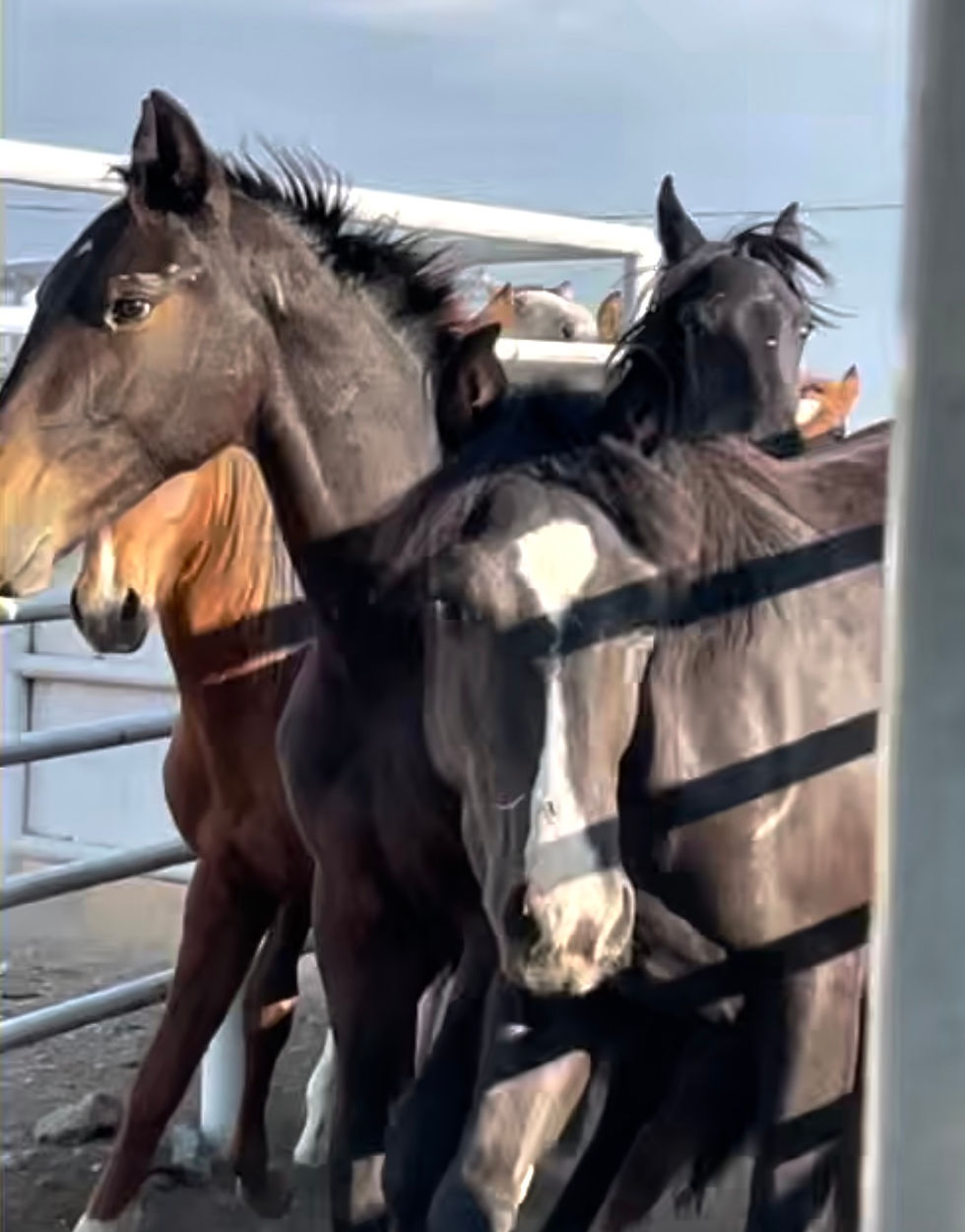
Over 80% of Americans are against horse slaughter – it’s time our legislators listened to their constituents and close these loopholes in protection of these American icons.
Clearly, education about the slaughter pipeline is also very important. Many people still don’t know the difference between slaughter and humane euthanasia. Many don’t know that over 92.3% of horses in the pipeline are young and healthy according to the USDA. When we bring these facts to light, we help the horses. Over 80% of Americans are against horse slaughter – it’s time our legislators listened to their constituents and close these loopholes in protection of these American icons. The more people know the facts and understand the better we can help make the world.
What Does the Future Hold for Liberty Sanctuary?
EquuStyle: Regarding the sanctuary's future, how do you balance the roles of volunteers, donors, and your adoption program to maintain operations? Additionally, could you elaborate on the challenges and importance of acquiring property with adequate water rights in the West?
Debra West: Great question and so timely! These roles blend quite often. Our volunteers are our absolute strongest supporters. With just over 75 volunteers right now, our volunteers care about the Liberty Herd so much that they are amongst our most consistent donors and represent more than 70% of adoptions. We share the work we do online and more people seem to be drawn to the help the Liberty Herd and all of America’s most vulnerable horses through advocacy.
Regarding water in the west – it’s absolutely critical to sustaining operations – and it is prompting us to leave Utah for Colorado. Utah has been so supportive of Liberty Sanctuary and our volunteers here are incredible but we have made the decision to move to Colorado where land and water are more accessible. We are on 80 acres in Utah but only 1.5 acres of that is irrigated pasture and I think there are more sustainable options in Colorado. We are excited for our next chapter in the state of Colorado and I’m dying to get the new wild horse license plate!
Halting the Slaughter of Horses and Burros
EquuStyle: What is the primary message you want readers to take away from your story?
Debra West: Liberty believes the best way to help make progress for the horses is through organized collaboration with other groups; in the equine world and outside of it. This work is not about ego or who takes the lead. I’d happily be an engine at the back of a well-run train any day if it meant we were making progress for America’s most vulnerable horses.
We know our key opposition is extremely well-funded and organized. We need that type of structure to educate the public and our legislators and truly affect change and restore wellbeing and dignity to our horses. I’d like for the public to know that there’s a place for everyone in our community and work. Whatever your talents are, the horses need you. They need us all! Reach out and we can discuss ways to work together! There’s no talent or task too big or small. It all helps.
Humans are responsible for creating the pipeline and all of this mistreatment – it’s our duty as humans to make things right!
The next projects we would like to collaborate with others on include the Horse Heroes Collegiate Challenge to activate young voters on college campuses to engage in advocacy efforts and also a collaborative rewilding program based in Colorado to give wild horses an option to be rewilded instead of held in BLM holding facilities with no quality of life. We have passion for these projects and seek partners to help bring these to life. debra@libertysanctuary.org
All images Copyright Liberty Sanctuary-all rights reserved. Cannot be reproduced for any purpose without permission from Liberty Sanctuary.