top of page

Magazine Articles

Updated: Jun 10, 2024

A rare interview with one of the world's top fine art equine photographers.


"Unicorn" is the title of Tony Stromberg's photograph of a Lusitano stallion taken in southern France.
Unicorn

Where are you from and how does that affect your work?


I grew up all over the west. My dad was a geologist for an oil company, and we moved constantly. 18 homes by the time I was 18. Very nomadic lifestyle, which is probably why I relate so well to the American wild horses… nomadic by nature. Because of all the moving, I became a loner at a pretty

early age. I am sure this has affected my work in many ways. I work best alone. In fact, when I was doing advertising photography, I would go back into the studio after everyone went home at night, and that’s usually when I did my best work. I get distracted when other people are watching and expecting me to perform, to the point where I can’t really focus.


"3 Brothers" by Tony Stromberg is a photograph of Merens breed horses running in a pasture in the Pyrenees region of southern France.
3 Brothers

Who are your biggest artistic influences?


That’s a hard one. There are not specific artists or photographers that I get inspiration from. Rather, I think it is an accumulation of everything I have seen, read, or heard throughout my life that has informed my artistic sensibilities. I also get a lot of inspiration from nature, and being

immersed in nature. I think all good art imitates nature in some way. We live in a very technical world and spend an inordinate amount of time in front of a computer screen or a phone. I think all the technology dampens creativity, and sometimes the best way to connect with our creative self is to unplug from all the technology and sit in silence so we can actually hear ourselves.


"3 Stallions" is the title of Tony Stromberg's photograph of three young stallions in Spain.
3 Stallions

How has your style changed over time?


It’s always a process. When I started doing advertising work, I was all over the map. I did fashion, food, technology, architecture, still life, catalog work, special effects, landscapes, because I didn’t really know who I was and had not defined my creative voice yet. I experimented a lot. I am completely self-trained in photography, and never went to school. I tried by doing, and by making a lot of mistakes, and learning what NOT to do. Over time, my personal style developed, but it took 20 years to find that. I spent years emulating the popular photographers, only to realize this was not me, and it was not coming from within. What I ultimately came to learn was that I had a deep appreciation for lighting.


"Luminious" is the title of a photograph of a beautiful galloping horse taken by fine art equine photographer Tony Stromberg at a guest ranch in northern Idaho.
Luminous

When I teach workshops, I tell people that they are not photographing a horse, they are photographing the light falling onto the horse. It takes a fundamental shift in understanding to really grasp that concept, but it is all about lighting. Photographers start with a black canvas, and we add light. We literally “paint” with light. After 20 years of studio photography, I learned how to “see” light. I am always looking for the light, so to speak. After I shifted my focus to horses, I realized I could take 20 years of experience in lighting and apply it to something I truly loved.


When is your favorite time of day to photograph horses?


Late afternoon, for sure. Magic hour. The last hour of sunlight is the best. In fact, in that late afternoon light, it is hard to take a “bad” photograph.


What motivates you to continue photographing horses?


I just love horses. I was burned out after 20 years of advertising work. I had lost myself after trying to be so many things and trying to please so many people. It’s a long story for another time, but when I started spending time with horses, they showed me a way back to my authentic self, and that was a huge gift to me. My work, I believe, continues to be an “homage: to the horse". I showed my true self to the horses, and in return, they shared with me their true essence, and that is what I try to convey through my work.


How do you define success as a fine art equine photographer?


When I was doing commercial work, it was constant marketing and it always felt like pushing a boulder uphill. When I started working with horses and started building a body of work with my equine photography, doors would open in front of me without much effort. The sense of struggle was gone. The 4 books I have published all came with little effort. When I started teaching workshops, I created them and people signed up, and it’s been going strong even efter 20 years of doing them. I think “success” is being able to do what you love and also make a living at it, without having to commercialize it or change it to fit someone else’s desire. I have a dream job. I travel the world photographing some of the world’s most beautiful horses, in some very beautiful places, and I get paid for it !!!


What have critics and collectors said about your work?


That’s an odd question. People that collect my work do so because it speaks to them on some level, and they love the work. I don’t think I have any critics, and if I do, I don’t really care what they think. At one point in my life, I would do whatever I could to please them, but not anymore. I know who I am, and I know my work has value. If someone does not like it, they do not have to look at it!


Why do you offer workshops and how do you benefit or find meaning from sharing your artistic mastery with other aspiring equine photographers?


Horses a book by Tony Stromberg fine art equine photographer

After my first book was published, along with calendars, people started to ask me if I would do

workshops, so I thought “why not”. I started doing a few in my hometown of Santa Fe, and it just grew from there. I am happy to share my photographic experience. It gives me joy to see people learning what I have to offer them, and I love to watch them grow artistically, and to find their own voice with their equine photography. They come to me because we all have a shared love of horses and photography and want to share our vision with the world. What’s not to like?


Click on the button to see more of Tony Stromberg's equine images

along with his stories behind these gorgeous photographs.


All images Copyright Tony Stromberg Photography -all rights reserved. Cannot be reproduced for any purpose without permission from Tony Stromberg Photography.


Updated: Jan 14

One of America's great contemporary fine Western Artists


I had the pleasure of meeting Michael Ome Untiedt in 1997, shortly after moving to Colorado. He generously donated an exquisite landscape oil painting to Rocky Mountain PBS for its fundraising event. The next day, Untiedt contacted me to pick up the painting I purchased the night before and to choose a frame. Needless to say, I was very excited to meet the artist who created such a gorgeous work of art.


Oil painting of a horse and rider on a wide trail, passing a structure with a brightly lit landscape in the foreground and storm clouds in the background by Michael Ome Untiedt, master painter of the American West featured in the Premiere Winter 2024 issue of EquuStyle Art & Travel Magazine at equustyle.com
Everything I Every Wanted to Say 24 x 30 oil on panel

Over the years I discovered that Michael Untiedt who is known as a master painter of the American West, is also a master storyteller and there is always a fascinating story behind each piece. One of the reasons I chose to purchase one of his gorgeous paintings during a PBS fundraising event was because of its intriguing title "Gates Open to the Sangre de Christos". Being a newcomer to Colorado, I did not know anything about the mountain ranges or the people who had lived on the land before. As you will discover by clicking each of the images of Michael Ome Untiedt's paintings, there is an enlightening and amazing story!


"Night Herd with Starry Night" is a 24" by 30" oil on canvas by master painter of the American West Michael Ome Untiedt who is featured in the Premiere Winter 2023 issue of EquuStyle Art & Travel Magazine @equustyle.com
Night Herd with Starry Night "24" x 30" oil on canvas

"Night Herd with Starry Night" is a classic Untiedt nocture. The artist's talent for creating these works are often compared to the nocturnes of American painter and sculptor Frederic Remington (1861-1909).


In this scene, Untiedt uniquely captures the peacefulness and subtle colors of a solitary cowboy watching over his herd in the moonlight.


Discover more by clicking on the painting to read Untiedt's story that inspired this remarkable work.


Michael Ome Untiedt's Stories Behind His Paintings


Explore the stunning works of Western fine artist Michael Ome Untiedt and discover the stories behind each breathtaking piece. EquuStyle Art & Travel Magazine is thrilled to share Untiedt's genuine talent and passion for storytelling with our readers.


Click or double click on the center of a painting to open the page where you may discover Untiedt's backstory about his pieces and how they are influenced by the world of the American West. You will experience the beauty, history, and culture of this timeless region.


Galleries where you may purchase paintings by Michael Ome Untiedt


InSight Gallery in Fredericksburg, TX

Cawdrey Gallery in Whitefish, MT

Sanders Gallery in Tucson, AZ

Legacy Gallery in Scottsdale, AZ

The Adobe in Ruidoso, NM


All images Copyright Michael Ome Untiedt -all rights reserved. Cannot be reproduced for any purpose without permission from Michael Ome Untiedt.


Updated: Apr 2

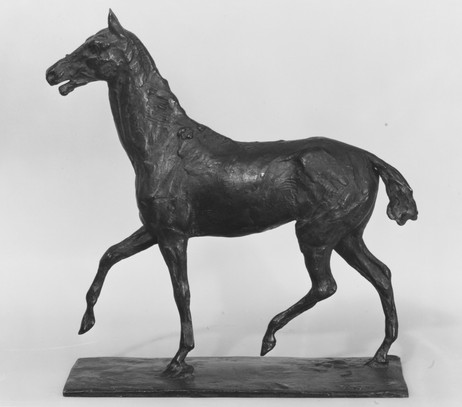
A bronze sculpture of a galloping horse on a simple base, set against a plain background. The horse's dynamic pose suggests motion.
Horse Trotting, the Feet not Touching the Ground

During Degas' lifetime, none of the more than 150 figurative sculptures he created were publicly exhibited, a fact that reflects the artist's complex relationship with the medium of sculpture. While Degas is predominantly celebrated for his remarkable paintings and pastels, particularly those capturing the grace and movement of ballet dancers, his foray into sculpture reveals another dimension of his artistic exploration.


The sculptures, often cast in wax or clay, were typically intended as studies for his paintings or as personal expressions of his fascination with the human form and movement. This lack of public exhibition during his lifetime adds an air of mystery and intrigue to his sculptural works, as they remained largely unknown to the art world and the general public until after his death.


Most of his sculptures were modeled before 1865, a period that marked significant development in the artist's approach to form and movement. The sculptures he produced during this time were not merely exercises in three-dimensional form; they were explorations of the dynamics of motion and the subtleties of posture.


By choosing not to cast his sculptures, he retained an element of intimacy and fragility that could be lost in the more permanent mediums.

Degas' reluctance to reproduce his sculptures in permanent materials like bronze or marble highlights his belief that the ephemeral nature of wax or clay better captured the fleeting moments he depicted. By not casting his sculptures, he preserved their intimacy and fragility, which might be lost in more permanent mediums. The raw wax models conveyed immediacy and spontaneity, allowing viewers to connect with his artistic process and vision.


This decision also highlights Degas' intricate connection with the art community and his personal artistic identity. He frequently viewed himself primarily as a draftsman rather than a sculptor, and his hesitance to create enduring pieces might suggest a wish to maintain a level of privacy and intimacy in his artistic pursuits. Consequently, the sculptures can be interpreted as a conversation between the artist and his materials, underscoring the ephemeral nature of life and art.


A bronze sculpture of a horse lowering its head, with textured surface and dark patina, set against a neutral gradient background.
Horse with Head Lowered

Nevertheless, Albert Bartholomé, a sculptor and close friend of Degas, prepared each figure for casting, a process executed by the esteemed Paris foundry A.-A. Hébrard et Cie. It is essential to mention that Degas' heirs authorized the casting of bronze copies to preserve the compositions and sell them as finished works. In addition to the visual appeal, the use of bronze as a medium adds a layer of durability and timelessness to the sculptures, allowing them to withstand the elements and be appreciated for generations to come.


The brief video showcases just a handful of the 72 horse sculptures that were meticulously cast in bronze, each one representing a unique artistic vision and craftsmanship. These remarkable sculptures capture the elegance, strength, and beauty of horses, which have long been revered symbols of freedom and power throughout various cultures.


Currently on display at The Met on Fifth Avenue in New York City are Edgar Degas' 72 equine sculptures. This exhibition provides a unique opportunity for art lovers and the general public to discover these lesser-known pieces. The sculptures highlight Degas' acute observation of horses in motion, capturing their dynamism and elegance. His meticulous attention to detail and fluidity of form reveal a profound understanding of anatomy and movement, developed through years of studying dancers and horses.


A bronze horse sculpture depicts a grazing motion on a textured base. The setting is neutral, highlighting the dark, realistic details.
Horse at Trough

Visitors will encounter works that showcase Degas' technical prowess and themes of grace, strength, and the transient nature of beauty. The exhibition connects his renowned paintings with his lesser-known sculptures, enhancing appreciation of his artistic legacy. This display at The Met celebrates Degas' contributions and fosters dialogue about the importance of sculpture in his work, inviting admiration and reflection.


The fact that his sculptural works were not publicly exhibited during his lifetime adds an element of mystery and intrigue to them. Degas' sculptures from this pre-1865 period not only showcase his innovative approach to capturing movement and form but also highlight his ambivalence towards the permanence of art. His decision to refrain from reproducing them in more enduring materials invites a deeper contemplation of the nature of artistic expression and the value of impermanence in the creative process.


Subscribe to get exclusive updates

Subscribe today and receive a quarterly email to inform you about the upcoming

digital issue of EquuStyle Art & Advocacy Magazine.

Share via

© Copyright Protected

EquuStyle Magazine ©2023-2025 EquuStyle.com All rights reserved.

Privacy Policy

bottom of page