- Robin Black

- Sep 3, 2024
- 8 min read
Updated: Nov 29, 2025

EquuStyle: As an internationally-acclaimed, award-winning, realistic wildlife artist, can you share the story of your artistic journey?
Carla Grace: I have been on an artistic journey my whole life without realising it. I never wanted to become an artist, but once I started studying at university, I quickly realised that I didn’t want to do anything else.
In hindsight, I began my career at 14 when I sold my first painting and won a major school art prize. I spent many years throughout my childhood in different parts of Africa, which is where my passion for wildlife came from. We were living in Zambia when I started to earnestly pursue my skillset in pencil portraits, doing commissions for pocket money from the age of 17. I even had a waiting list at that age, and so figured I would end up doing something with my skills eventually.
I trained myself hard in those early years, often staying home when others were out being social. Even during university, where I studied fine art for two years before dropping out, I was doing art on the side for extra cash. When I dropped out of uni and moved to Australia at age 23, I dedicated myself to setting up my art business and pursing it as a full time career. It then took me 4 years to make that a reality as I slowly transitioned away from a supplementary full-time job, to doing more and more art, until finally it was my full-time career.
EquuStyle: Which piece are you most proud of, and what’s the story behind it?
Carla Grace: I am most proud of a very large scale painting of flamingos I did in 2023, and a large scale white on white painting of a horse entangled in fabric completed at the start of this year. Both of these pieces are significant in that they were made up from many different images which otherwise could not be captured in nature. I took my concepts for both pieces past reality, instead making a slightly fantasy, and slightly surreal composition. This is stronger in the horse painting than it is in the flamingo piece. I am proud to say my flamingos are now being displayed in a Museum in Wisconsin, USA.

Troupe Flamboyance Carla Grace 
Carla Grace wildlife artist
EquuStyle: Can you describe your painting process, from the initial idea to the finished piece?
Carla Grace: My painting process begins with an idea. I always see the painting I want to create in my mind before I source imagery to support it. This is why my paintings often require many different images stitched together to make up the whole composition.
Once I have found images, or created images to make up all the different parts of the painting, I will put them together in procreate, on my Ipad. This digital representation of the painting needs to happen in order for me to see the ideas come together fully. Some elements I don’t need to see, but the overall structure needs to be realistic before I start committing it to the painting. Once I am happy with the composition on the iPad, I will begin my sketch on the canvas and let the process go from there. I have begun limiting myself to two passes of paint only. This means that I cram as much detail in each application of paint, but then force myself to walk away after the second one is complete. This means that my paintings are becoming more and more unrefined, and painterly.
I have a tendency to paint to perfection, but don’t want to continue in this way because I want to do what a camera cannot do - and that is create texture and expressive marks with my paint.

Cheetah painting Carla Grace 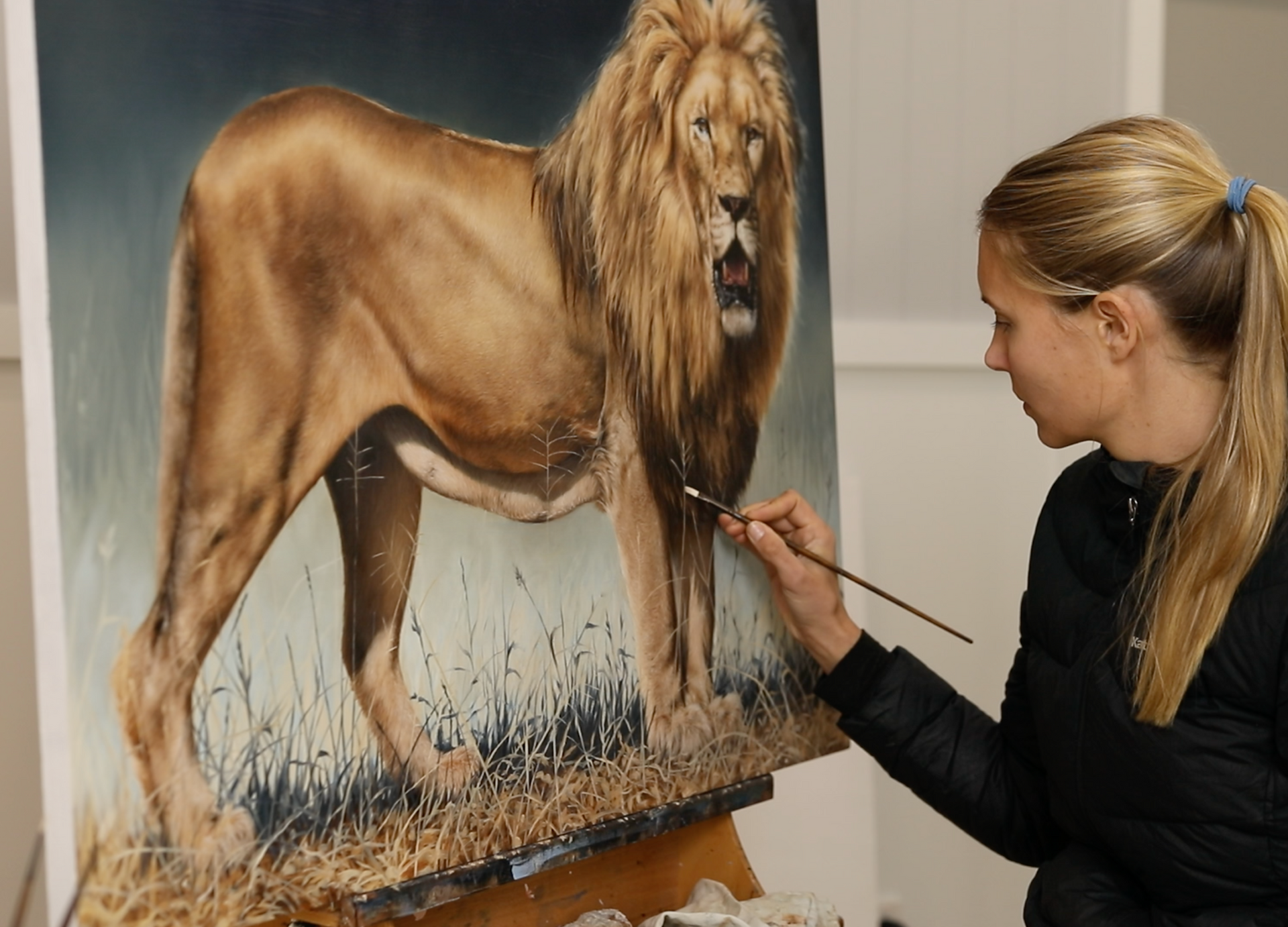
Carla Grace wildlife artist 
Skin to Skin by Carla Grace 
Horse Acrylic Mini Tutorial 
Carla Grace wildlife artist
EquuStyle: You work with both oil and acrylic, sometimes on the same painting. What effect are you seeking to achieve when using the two mediums together?
Carla Grace: Acrylic is my speed medium, and so I tend to use acrylic for paintings that are required under a deadline, or that are smaller in scale. I will use acrylic for the base tones of the painting which is usually a very quick and basic application of paint to tone and block in sections of the painting. I am then able to begin working with oil paint on top of the acrylic base tones straight away, rather than waiting a full day for the base layers to become touch dry - which is what needs to happen if I used oil paint from the start. Acrylic also tends to be a lot more sharp in finish, where as oil paint has a higher blend ability and therefore I am able to create soft focus details a lot easier than if I did it with acrylic paint. Oil paint is much easier to work with (in my opinion) than acrylic paint for the larger scale paintings, which is why I will favour oil paint for those rather than acrylic.
EquuStyle: How do you approach the use of color in your work?
Carla Grace: I am self taught in all areas, so my colour theory is a little lacking. This makes me feel like I approach my use of colour with a lot of guesswork rather than accurate theory and understanding. Because of this, I have made colour theory my focus to understand and use as an asset to my process. Despite this, my colours always tend to be a little more neutral rather than saturated, leaning closer to what is accurate in nature.
EquuStyle: How do you approach the use of light and shadow in your paintings?
Light and shadow is everything in my work. Contrast and steep representation of value is key to my work. Just in the change between the values I am able to alter the colours to the point where they become vibrant - despite being over all very neutral. Contrast is one of my favourite ways to convey intensity and drama. Even the lack of contrast, when used correctly such as in my white on white painting of a horse, can convey something very powerful. So I approach it with care, and ensure that I get that part of each painting absolutely perfect.

EquuStyle: You offer several hyper-detailed tutorials in oil, acrylic, or both paints on your website. Why are you motivated to share your creative process with artists around the world?
Carla Grace: When I began my career in earnest, I chose wildlife not only because of my connection to the animals I grew up with in Africa, but because I noticed a severe lack of wildlife artists represented in the timeline of art history.
There seems to be a huge gap between the artists who paint wildlife, and artists who paint everything else, and that could be due to many different factors such as vision, conceptual power and overall artist value, but I saw a lot of good artists making good wildlife paintings - not masterful ones. A lot of this is because no one really teaches wildlife artists how to become better. There isn’t very little in the way of intermediate and advanced courses that teach artists how to paint with more skill and run a better practice. So I decided that when I got to the stage in my career that other artists were asking me to teach them, I would do just that. Since I have a lot of content on my platform, I have chosen to create a subscription based access offer, rather than sell tutorial individually - this makes it much more accessible to more artists.
Ultimately, It is my hope that wildlife art as a whole will get better, and start to make an impact in the timeline of art history. Hopefully I can start that process by showing other artists how to level up their game and become masters in their craft.
EquuStyle: What inspired you to create the tutorials “Full Horse Portrait in Oil Paint” and a “Horse Portrait Acrylic Mini Painting”?
Carla Grace: All of my tutorials on my platform are requested by the students who learn through me. Somewhere along the way artists have requested a horse tutorial and so I have created that for them. There is a lot more available in my exclusive content sections for those who are subscribed to my platform on a monthly basis, in addition to the individual tutorials. Horses can also be really hard to paint, especially if you have no idea where to start and how to achieve the simple effects of short hair and the long mane. Seeing how someone else dose it step by step is incredibly helpful.
EquuStyle: How do you balance your artistic creativity with the business side of being an artist?
This is a really challenging aspect of the practice. The business side is a full time job, and the artist side is also a full time job. Being in control of both aspects is almost impossible. It gets to a point where you need to delegate some jobs because otherwise you suddenly realise its been days since you last painted.
I am currently building my dream studio, and the balance between building it all myself, painting and running my business is full on. I am lucky that I love the business side of being an artist, and that I have a husband who now works with me. He helps me with alot of the admin and running of my online tutorial platform.
EquuStyle: Can you discuss a time when creating art helped you through a difficult period in your life?
Carla Grace: There have been times through out my life where being an artist has been the core of what has made things difficult. The insecurity of income and lack of guarantee in sales can cause significant stress. However, even though the industry can be hard to navigate sometimes, I find myself overwhelmingly grateful that I am able to do this full time.
Knowing that I can do what I love every day, and that collectors all over the world love my work get me through every rough patch. Since it is my daily job, I don’t usually make art for the fun of it anymore, so often I have to take a break from the studio when life gets too stressful, such as when my father in law passed away. I didn’t turn to art to work through the grief, even though many artists naturally would do that. This is something that has become a consistent theme, the more art I do for work, the less I do of it for fun. I have become ok with this over the years, and instead will focus on painting with my kids for the fun of it, teaching them and seeing the joy it gives them. I have found this to be more therapeutic and fulfilling during the difficult periods.

EquuStyle: Given many of the environmental and wildlife crises around the world, what role do you think your art has in society?
Carla Grace: I want people to feel the animal through my work and experience creatures like they wouldn’t otherwise be able to. I want each painting to create a closeness between the viewer and the animal, and to feel like it could draw breath at any moment.
There is a process of immortalisation when something is committed to paint. I feel like it is incredibly respectful to recreate anything with care and true to life details.
As the artist, I am looking at the animals with much more intensity that I ever could in passing. Im taking in every detail and every imperfection that makes them the way they are. It’s more than what can be achieved in a photo. A painting takes a 2 dimensional surface and turns it into something that requires the very best of both the creator and her subject to succeed.
EquuStyle: How do you hope your art will impact viewers on a deeper level?
Carla Grace: I hope that my work inspires awe, that it takes the viewers breath away. From my classic range of wildlife portraiture, I hope that the viewer feels a kinship with the animal. This connection comes from the pure beauty of the animal itself and my technical ability to create it on the canvas.
My signature range is focused on creating a narrative, and I add elements that are intended to provoke a response based on the viewers individual understanding, for example, “Skin to Skin” has been known to provoke both admiration and disgust. Both responses to the painting are a success because it is the reasons behind the response that I am most interested in. If a painting can provoke an emotional response, while still being stunning in its own right then I have succeeded as an artist.