top of page

Magazine Articles

Three colorful donkeys in vibrant shades of purple, blue, and red on a bright yellow background, captured in an expressive painting by Barbara Meilke.
Three vibrantly painted donkeys share a moment of wisdom, embodying the theme "Listen To Your Elders" with colorful expressions and a golden backdrop. Oil on canvas, 12”h x 24”w

The Spark Behind Barbara's Journey


EquuStyle: How did you become interested in painting and sculpting donkeys?


Barbara Meikle: I was born a horse lover, learned all about the donkey when I had to caretake a pair of riding mules. Fell in love with their intelligence and personalities, visited a donkey rescue in Colorado, Longhopes, and was hooked! Wanted to paint them as much as I painted horses…


Two colorful donkeys nuzzle affectionately in a vibrant, abstract painting with bold brushstrokes and a turquoise background.
Playful and vibrant, these colorful burros exude an irresistible charm, capturing hearts with their lively energy. "Getting a Bit Rowdy" Oil on canvas 16"h x 16"w

EquuStyle:  Do you aim to portray the individual personality of each animal, or a more general 'essence' of a donkey?


Barbara Meikle:  I actually try to do a little of both, there are individual traits like the length of coat, the dorsal stripe, etc., and then there is the gentle eye, the tilt of the ear when you’ve caught their attention that seems universal in the donkey world.


EquuStyle:  How does your relationship with donkeys influence the way you portray them?


Barbara Meikle:  I try to capture the physical differences between horses and donkeys because that is a distinction that is important to the physical presence of the horse vs the donkey—the angle of the head, the straightness of the back, smooth coat vs shaggy. My love for them lets me give them big brown eyes, a mischievous expression and the ability charm themselves out of trouble!


EquuStyle:  What feeling or mood do you hope a viewer experiences when looking at your paintings and sculptures?


Barbara Meikle:  Happiness! Joy, beauty, the chance to just absorb a beautiful energy for no reason other than you love that creature.


Exploring Donkey Artistry: Techniques in Paint and Clay


EquuStyle:  How do you think the medium (painting vs. sculpture) changes the way you represent donkeys?


Barbara Meikle:  Paintings give me a chance to be more experimental and play with abstract ideas of color, texture and movement. The sculpture keeps me grounded in the realities of 3 dimensions so I need to get the proportions right from every angle and make it interesting at the same time.


EquuStyle:  How do you apply impressionist techniques, such as visible brushstrokes and an emphasis on light and movement, to capture the essence of a donkey?


Two colorful donkeys in a vibrant, abstract setting. Bright strokes of blue, orange, and pink create a lively, energetic mood.
Stepping Into The Sun, oil on canvas, 30”h x 30”w

Barbara Meikle:  I start with a brush to sketch in the subject and then I usually use a palette knife to scoop up paint and put thicker layers on the canvas. I mix up the colors and the values, using brights and pastels to show movement by losing edges, overshoot the color so I can use the background to cut in the image of the donkey.


EquuStyle:  Which visual elements—color, light, texture, or form—do you feel takes priority in your work, and how does that choice impact the final painting?


Barbara Meikle:  All of these elements are part of my work. The color is are important because it is expressive color. It’s emotional. It’s how I feel about the animal. The light helps anchor the painting in some sort of reality!


I use so much texture because I use a pallet in life and it actually helps to build up the character of the animal as well as the surface of the painting. And form is important because even though I might stray, I still like to get the donkey or the horse or the lion or the zebra correct, in other words I like to make sure that I can draw them well before I paint them.


Influences, Creative Process, and Challenges


EquuStyle:  Are there any other artists, within the impressionist movement or wildlife art community, who have significantly influenced your work?


Barbara Meikle:  All other French impressionists, such as Monet, Pissarro, Sisley, Morisot were important to me. Also, the outliers, such as Manet, van Gogh, Toulouse-Lautrec, and Bonnard, all have things to offer for me in terms of a subject matter color and the process of making art.


Five colorful donkeys in a vibrant, abstract painting. Bright hues of blue, pink, orange, and green create a lively, energetic mood.
These jennies are waiting oh so patiently for their midday meal! “The Ladies Who Lunch.” Oil on canvas, 24”h x 12”w

EquuStyle:  What is your process for creating the work? Do you use photo references, live models, or memory and imagination?


Barbara Meikle:  I love to paint from life, I love to paint "en plein air" as they say, in the open air. I also paint from photographs, as I travel to places such as France, Africa, our national parks, to photograph the wildlife that I want to paint. And lastly, because I have been painting and drawing animals particularly for almost 50 years really, I use a lot for my own imagination.


EquuStyle:  What technical challenges did you face when capturing the form or texture (e.g., fur, muscle, movement) of a donkey, especially in sculpture?


Barbara Meikle:  Sculpture is what I like to call the long game, because you first create an armature, or a skeleton for the piece and then you covered it in clay. And then you just tweak, tweak, tweak, tweak, tweak. You constantly find things you need to change, the confirmation of the animal, the length of years of the donkey, how you place their feet.


I usually do a painting in a few days because I’m fast with painting, but a sculpture can take me weeks or months. You have to keep coming back to it to double check it to make sure that it’s what you want, because once you give the clay sculpture to the mold maker, you can’t make any more changes.


EquuStyle:  What emotions or ideas do you hope viewers take away from your work?


Barbara Meikle:  I just hope people learn to enjoy the donkeys and horses and other creatures I paint and sculpt, for themselves and see them as individuals. In a way, they’re just like us.


Passions Driving Her Professional Journey


EquuStyle:  How do your interests outside of art fuel your artwork?


Barbara Meikle:  I have horses that I ride and they constantly keep me thinking about how I would be painting them, and I do a lot of trail riding so I get to see the landscaping and then once again I’m thinking about how would be painting that landscape. When I visit the donkey rescues I always enjoy the crowds of animals that come around and so that gives me ideas also.


Smiling woman with curly blonde hair, wearing a turquoise necklace and plaid shirt. Bright abstract painting in vibrant yellow and red behind her.
Fine artist Barbara Meikle stands in front of her vibrant abstract painting, wearing a turquoise necklace and a colorful plaid shirt, embodying her creative spirit.

EquuStyle:  What do you like most about being an artist?


Barbara Meilke:  I love everything about being an artist, the challenges, the freedom, the fact that I am creating something that is unique. And I also love being able to earn a living as well as help out some of the rescues that I think are absolutely amazing.


EquuStyle:  In what ways does living and owning a gallery in Santa Fe impact your art?


Barbara Meikle:  Santa Fe is the third largest art market in the country, after New York City and Los Angeles, California, so there are lots of people that come here just to collect art. But I like to say that New York is investment , Los Angeles is trends, and Santa Fe is Heart because people come from all over the world to fall in love with something that they want to take home and remember their visit to our beautiful city.


Harnessing Creativity for Compassion: Barbara Meikle's Art Supporting Animal Rescues


EquuStyle:  What would like art enthusiasts to know about Barbara Meikle Fine Art?


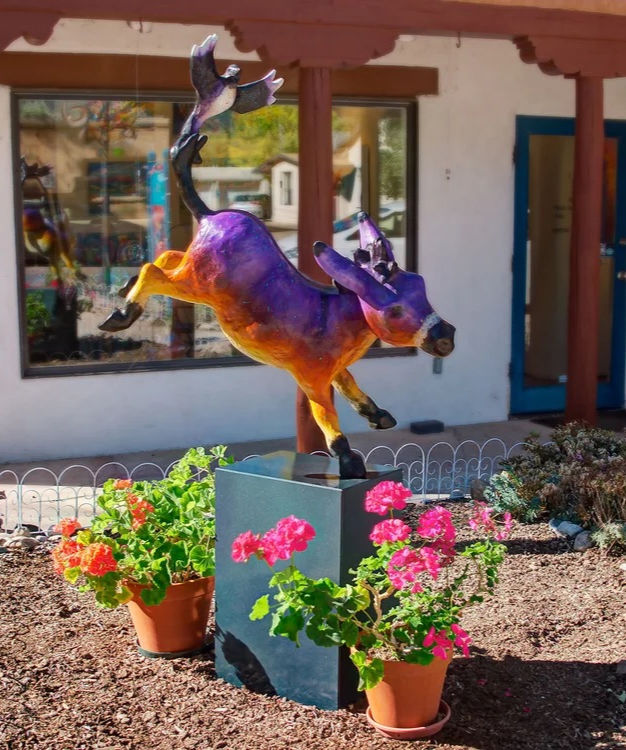
Colorful sculpture of a purple and orange animal with a bird on its tail, surrounded by potted pink flowers in a garden setting by artist Barbara Meilke Fine Art.
A vibrant sculpture titled "Hijinks Life-size" is prominently featured in front of Barbara Meikle Fine Art Gallery in Santa Fe, New Mexico.

Barbara Meikle:  My gallery is a wonderful place to find original work, with lots of color, emotion, and love. I’m often there painting or sculpting, so you can see an artist actually working, which is come to be a rare thing. we also have  live animal events several times a year, where I have donkeys and birds of prey, come to the Gallery from the different rescues that we support, so I paint them as they pose, while we help them raise money.


EquuStyle:  For 19 years, you have been raising money through the sale of your artwork for horse, donkey, and wildlife rescues across the country, in the region, and in the state of New Mexico. Is this one of the more gratifying aspects of working as an artist?


Barbara Meikle:  Yes! It’s always been easy for me to sell my work because I seem to love to paint and sculpt the things that other people love as well. So be able to give some of that back, to the animals that have inspired me throughout my career, just makes my work more meaningful, not only to me, but to people that collected as well.


EquuStyle: What initially drew you to the world of equine art & sculpture?


Sandie Henderson: I have always loved cats, horses and art, and my life seems to have been inextricably linked to these three subjects. 


Bronze horse sculpture with one hoof raised, set against a plain white background. The greenish patina highlights its elegant form.
Bronze sculpture titled "Cavallo," showcasing elegant equine form with a patina finish, measuring 51cm in height, 54cm in width, and 27cm in depth.

I was lucky enough to grow up with both cats and horses, and have many happy childhood memories of making life drawings of them. I didn’t come from an artistic family but my father kept me well supplied with drawing materials and I developed useful drawing skills. Back in those early days sculpture was not yet on my radar, but I was always a fairly hands-on practical person who enjoyed making things. These earlier “making” experiences were valuable when years later I turned to sculpture.


After leaving school I worked as a draughtswoman in engineering and architectural drawing offices, before training for a British Horse Society teaching qualification. For over twenty years I enjoyed a career in the horse industry, teaching riding, training, breeding and judging horses. I’ve also been closely involved with feral cat welfare for many years.


EquuStyle:  Was there a specific horse, experience, or image that ignited your passion for sculpting horses? 


Sandie Henderson:  Two tragic horse related events in 1997/98 formed the catalyst for change that catapulted me into the art world and initiated my journey into sculpture.


“Bacchus” was a charming and incredibly handsome young home-bred colt (Thoroughbred x Cleveland Bay). He was full of joyful exuberance and had amazing presence. He broke his neck in a distressing freak accident at liberty in the paddock. Nothing could be done to save him and I was heartbroken.


Two months later my little cat “Kit” was fatally injured by a young pony that was with me for schooling. Kit was an orphan kitten who lost his feral cat mum when he was only a few days old. I hand reared him and he grew into an amazingly happy and healthy young cat. We shared an incredibly close bond and he was my constant companion. I was devastated by his loss, especially so soon after loosing Bacchus, and I found it impossible to continue with my then lifestyle. I felt the need to step back from the horse industry and immerse myself in the healing power of art. 


The idea of making a sculpture for Kit’s grave became important to me and somehow I knew that I could do it. Never having been a particularly self-confident person and with no previous experience of sculpture, this amount of confidence was surprising and out of character. I enrolled on a short part time sculpture course at a local college, and was taught the basic carving skills that enabled me to carve my Kit sculpture in aerated block. The sculpture has now become a treasured memento of Kit.


I found myself incredibly drawn to sculpture and decided to study the subject in more depth, initially by completing a Foundation Course in Art & Design, followed by a Fine Art Degree Course, specialising in sculpture. Art in general proved to be a wonderful therapy, effectively helping me through a difficult time in my life, and in sculpture I felt I had found my calling.


Horses have always played a major role in my life so after graduation in 2002 it seemed only natural to make Equine Sculpture the primary focus of my art practice.  


EquuStyle:  How would you describe your unique artistic style when it comes to sculpting horses?


Sandie Henderson:  My style is essentially contemporary, though its roots are very much grounded in antiquity. Major influences include Ancient Greek, Etruscan and Tang Dynasty Art.


My aim is to capture the inherent characteristics of the horse, particularly its essential power and dynamic energy whilst in motion. I look for an elemental spirit of the wild that connects my horses to the landscape of their environment.

I continue to be inspired by the striking images in my modern day edition of Xenophon’s “The Art of Horsemanship”, the earliest known written work on training the horse. Xenophon was an Ancient Greek military leader, philosopher and historian, sometimes referred to as the father of horsemanship.


The classic 1766 publication “The Anatomy of the Horse” by George Stubbs is also a wonderful source of inspiration and reference.


Significant contemporary influences include Dame Elizabeth Frink and Marino Marini.


EquuStyle:  Can you talk us through your typical creative process, from initial concept to the finished sculpture?


Sandie Henderson:  My creative process starts with the exploration of ideas. I look through a variety of images, typically in books, magazines, photographs and sketch books, until something inspires me. I also make sketches from life. 


Once the basic concept for the sculpture has been decided on, I select at least one image to use as a general guide. I like to allow freedom for the sculpture to develop fairly organically, resulting in a finished sculpture similar to the guide image but not identical. By allowing for a degree of artistic freedom and licence I am more able to highlight aspects of the horses physique and spirit.


Whether I’m working on a Modelled or a Constructed Sculpture, I start with a very simple armature built from mild steel rod or fencing wire. The armature is bent into the required shape to mirror the stance and action of the horse, then built up with chicken wire to roughly define the form.

Some of my sculptures are made entirely of chicken wire, in which case I just carry on building up the wire until I am happy with the form. 


For a modelled sculpture less chicken wire is used around the armature, then clay or plaster is  added to complete the piece.


EquuStyle:  What materials do you prefer to work with and why?


Sandie Henderson:  To create my equine sculptures I work with a wide variety of materials and processes. Modelling is the process I most often employ, but I also enjoy carving, installation and construction. Whatever sculpture media I’m using I try to work in harmony with my materials rather than being overly dogmatic in my approach.


Modelling:

For modelling I mostly use air drying clay, apoxie-sculpt or plaster. All three of these modelling materials allow me to gently sand back into the almost completed dry sculpture to further refine and enhance the piece. This close “hands-on” approach probably draws on past experience of grooming horses, an activity that I find to be one of the best ways to become familiar with the physique of the horse.


My most successful modelled sculptures usually get cast into foundry bronze and are sold through gallery outlets.

Stone sculpture depicting riders and horses in relief, with a horse head sculpture on top. White background, calm and classical feel.
"After Xenophon" features a carved aerated block on slate, depicting dynamic equestrian figures and crowned with a horse head. Dimensions: 56cm(H) x 90cm(W) x 40cm(D).

Carving:

My earliest carvings were in aerated block (sometimes known as expanded cement), a good and inexpensive carving medium that is ideal for the novice sculptor to use while developing carving skills. More recent carvings have been in soapstone which is not dissimilar in hardness to aerated block, making it the perfect natural stone to progress to after aerated block.


Sculpture Installation:

Sculpture installation enables me to effectively address current issues that interest or concern me. Perhaps my most successful sculpture installation and also my personal favourite is “Finding Zen”, a celebratory piece that pays homage to The Horse. Consisting of wire and slate, it responds to man’s recent more “holistic” interactions with the horse, and references the development of horse based therapies such as Equine Experiential Learning and Equine Facilitated Psychotherapy.


Sculpture of a horse made from black wire, displayed on a white slate platform, encircled by stones. The setting is minimalist and serene.
A graceful wire sculpture of a horse stands poised within a circular arrangement of slate stones on an MDF board, embodying the theme "Finding Zen" with its serene and balanced presence.

Occasionally I am inspired to make artwork that is not horse related. The “Threatened Pollinators Installation” addresses current concerns relating to the use of neonicotinoid pesticides and a decrease in the bee population. 


Construction:

My chicken wire sculptures are made using the construction process. Being essentially very pliable and easily bent into shape, chicken wire is well suited to depicting the physique and action of the horse.


It’s a fairly lengthy but effective process involving weaving wires together and ultimately ensuring that no sharp ends are left! Gloves are essential, together with a selection of pliers. A hammer also comes in useful to assist in defining the shape.


EquuStyle:  How do you capture the movement and spirit of the horse in a static sculpture?


Sandie Henderson:  Spending time with horses, be it through observation, sketching, riding or grooming, is an incredibly effective way to become familiar with the physique, behaviour and spirit of the horse. Direct contact with horses will inform the sculpture, and help to animate it.


EquuStyle:  What are the most rewarding aspects of your work?


Sandie Henderson:  Perhaps my greatest reward is simply my enjoyable lifestyle, with its joint focus on horses and art. I consider myself incredibly lucky. 


Through my work I continue to make valued friendships in both the horse world and amongst the artistic community, and coming into contact with so many lovely horses is a wonderful bonus. 


EquuStyle:  What advice would you offer to aspiring equine sculptors?


Sandie Henderson:  Get to know your subject by spending as much time as possible with horses. 


Go out and sketch horses at rest and on the move. Note their action throughout the different paces, walk, trot, canter and gallop. Observe and absorb horse physique and behaviour. Take photos, 


Look at the work of other artists and note the very many different approaches to equine sculpture.


A basic knowledge of horse anatomy is useful. “The Anatomy of the Horse” by George Stubbs is amazingly informative.


Riding horses is a great way to become familiar with the feel of the horse in action. Once acquired, this inherent “feel” will help to animate the sculpture on an almost instinctive level. Consider taking up riding if you’re not already a rider.


Be aware of structural issues that will effect your horse sculpture (e.g. big body on fine legs). Consider the size and shape of your sculpture and use suitable materials to address the structural issues.


Constantly assess how your sculpture is developing three dimensionally. A revolving modelling stand is valuable in this respect.


Try to work with your materials and not against them, allowing them the freedom to express their inherent qualities. With experience this will become easier.


Specialist training is beneficial and lots of useful advice can be found in books or on-line. Consider enrolling on a sculpture course, take advice from experts and look out for suitable workshops.


Appreciate and capitalise on “happy accidents”. They are a gift from the art gods!


When you’re ready, look for opportunities to exhibit your work. It will be hugely rewarding to see your sculpture on display!


EquuStyle:  What role do you think equine art plays in celebrating and preserving the legacy of horses?


Greenish-blue bronze sculpture of a horse's head on a rectangular base, set against a plain white background. No text or patterns visible.
“Trojan War Horse” Bronze (Blue Patina) Size 16cm(H) x 10cm(W) x 9cm(D)

Sandie Henderson:  Through the ages, equine artists have celebrated and preserved the legacy of the horse by visually representing its historical and cultural significance. They have captured its spirit and beauty and documented its impact on our culture and society. 


Equine art has captured the unique characteristics of specific horse breeds, and served to keep alive the memory of breeds now no longer in existence. In a similar way, horse portraits through the ages have recorded the lasting bond between owners and their beloved companions for generations to come.


Contemporary artists continue to explore equine imagery using a wide diversity of styles and materials and horses remain a relevant and inspiring subject in art and modern day culture.


Perhaps the relatively new medium of Sculpture Installation might effectively be used to highlight current concerns relating to America’s wild horses and burros (perhaps this is already being done?). 


It is good to note that a number of very talented equine photographers are creating stunning images  to address these issues of concern to great effect.


EquuStyle:  Tell us about a particular equine sculpture that holds special significance for you. Why is it important?


Sandie Henderson:  The stunning Horse of Selene sculpture, currently housed at the British Museum, is without doubt my favourite equine sculpture and holds particular significance. I came across this renowned marble piece from the Parthenon, as a first year sculpture student on a visit to London and well remember its tremendous impact. It moved me deeply.


The sculpture depicts the head of one of the horses of the moon goddess, Selene. The horse’s expression, with pinned back ears, gaping jaw and bulging eyes, conveys the intense effort and exhaustion of pulling Selen’s chariot across the night sky.


EquuStyle:  Are you currently working on any projects you’re excited about?


Sandie Henderson:  My tired old studio building sadly reached the end of its days earlier in the year and I have a new studio currently under construction. Whilst the prospect of a new studio is tremendously exciting, being temporarily without a studio has impacted heavily on the development of new work. 


Artist with long hair sculpts a horse model in a studio. Shelves with horse figures and a wall art of a horse in the background.
Equine sculptor Sandie M. Henderson works on a horse sculpture in her former studio, surrounded by artwork and tools of her craft.

However, despite less than ideal conditions two new sculptures are slowly taking shape in my kitchen. One is a small cantering horse and the other, a larger Etruscan themed horse. Both are in air drying clay and when complete they will be cast into foundry bronze, always a very special and exciting process. 


EquuStyle:  What are your aspirations for the future of your art?


Sandie Henderson:  In the immediate future I’m looking forward to the completion of my new studio and having a comfortable working environment once again.


Longer term, I will be seeking out more gallery representation and exploring new creative ideas, processes and materials. 


My particular interest at the current time lies in depicting the spirit of the horse at liberty and its connection to the landscape. I will continue to explore these themes.


All images Copyright Sandie M. Henderson and Carnes Fine Art Gallery -all rights reserved. Cannot be reproduced for any purpose without permission from Sandie M. Henderson and/or Carnes Fine Art Gallery.


Subscribe to get exclusive updates

Subscribe today and receive a quarterly email to inform you about the upcoming

digital issue of EquuStyle Art & Advocacy Magazine.

Share via

© Copyright Protected

EquuStyle Magazine ©2023-2025 EquuStyle.com All rights reserved.

Privacy Policy

bottom of page