top of page

Magazine Articles

Kenneth Peloke, using oil on large-format canvases, views the horse not as a mere subject but as a medium for channeling energy, instinct, and a presence that defies simple representation in paint.

A fine art monochromatic painting by Kenneth Peloke of horses gallop side by side, manes streaming against a plain pale background, creating a sense of motion and power.
Rolling Thunder, 46" x 90" Oil on Paper over Panel

The Aesthetic of the West


Kenneth Michael Peloke (b. 1978) is a contemporary artist residing in the American West. He is renowned for his distinctively stylized, abstract, and frequently hyper-realistic paintings that depict wildlife and cowboy culture. His artworks are characterized by heavily abstracted figures and striking, graphic styles that express the intense emotion of the American frontier.


Peloke has dedicated his career to capturing an elusive essence: the spirit of the American West. Non-representational figurative art resonates profoundly in a home for a reason. When a face is abstracted, the figure becomes universal, transforming from a specific individual to anyone, including you. Emotion resides in the gesture, the color, the weight of the composition, with the viewer contributing the rest.


His horse paintings stand out in the world of equine fine art for their unique monochromatic style and deep emotional resonance. Ken's work captures the essence of horses not just as animals, but as symbols of nature’s raw power and grace. For collectors and horse enthusiasts alike, Peloke’s paintings offer a fresh perspective on equine beauty, blending technical skill with a personal journey that spans decades.


The Early Artistic Journey of Kenneth Peloke


Equine fine artist Kenneth Peloke dressed in black T-shirt and tan Brixton cap stands beside his large-scale monochromatic painting of horse head, calm and serious.
The Artist with "Guardian" 60 x 48, Oil on Panel

Born in rural New York, Kenneth Peloke’s artistic path began under humble circumstances. As the youngest of four children raised by a single mother, Ken’s access to traditional art materials was limited. Instead, he improvised with crayons, pens, house paint, cardboard, and even the walls of his home. This resourcefulness laid the foundation for his creative spirit.


At age nine, Ken’s family moved to Arizona, where private oil painting lessons and a visit to Sedona inspired him to focus on landscapes. Throughout high school, he painted scenes of the natural world, though he often felt disconnected from academic studies. His success in juried art competitions during this time showed early promise.


Ken’s artistic focus shifted in community college toward figure painting and drawing, but frustration with his progress led him to explore graphic design. Although this detour was brief, skills in Photoshop, animation, and photography later enriched his artistic process. At 22, Ken stepped away from art for seven years, a hiatus that ended with the news of his first child. This life event reignited his passion, leading him to abstract painting and eventually to the fine equine art he is known for today.


The Monochromatic Style and Its Impact


Kenneth Peloke’s horse paintings are notable for their monochromatic palette, often using shades of black, white, and gray. This choice strips away distractions, allowing viewers to focus on form, movement, and emotion. The absence of color emphasizes the horses’ musculature, posture, and spirit, creating a powerful visual impact.


This style also reflects Peloke’s personal artistic evolution. His early abstract work, inspired by raw energy and non-subjective forms, informs the boldness of his monochromatic pieces. By combining abstraction with realistic detail, he captures both the physical presence and the intangible essence of horses.


A contemporary artist located in the American West, renowned for his distinctively stylized, abstract, and frequently hyper-realistic paintings depicting wildlife and cowboy culture. His artwork prominently showcases heavily abstracted figures and bold, graphic styles that express the intense emotion of the American frontier.


Peloke creates art in two unique styles: hyperrealistic wildlife and a more abstract, graphic style similar to silkscreen. The piece "Kickstart" belongs to the latter category, where the cowboy icon and the horse are reduced to core elements. He uses oils, Q-tips, paper towels, and drywall scrapers—whatever the piece requires.


Collectors of fine equine art appreciate this approach because it offers a fresh interpretation of a classic subject. Peloke’s paintings invite viewers to see horses not just as animals but as living expressions of nature’s beauty and strength.


Themes and Inspirations in Peloke’s Horse Paintings


Peloke’s work often explores themes of freedom, power, and connection to the natural world. His horses appear dynamic and alive, frozen in moments that suggest movement and emotion. This vitality comes from his deep understanding of equine anatomy and behavior, gained through years of observation and study.


The open fields of Upstate New York, where Peloke spent much of his youth, also influence his art. An area characterized by rich agricultural lands and stunning geography which links to his work when he paints animals in their natural environment.


After relocating to Arizona, he found himself immersed in an entirely new visual experience that was both striking and transformative. This connection to place adds layers of meaning, linking the horses to their environment in a subtle but powerful way. The horses depicted in his paintings are not just subjects but emblematic representations of their surroundings. The subtle yet powerful relationship between the horses and the desert underscores themes of resillience and adaptation, reflecting how life thrives in even the most challenging conditions.


Peloke’s personal story—his early struggles, artistic detours, and eventual return to painting—adds emotional depth to his work. Each piece reflects a journey of discovery and expression, making his horse paintings resonate with authenticity.


Why Kenneth Michael Peloke’s Work Appeals to Fine Equine Art Collectors


A large-scale monochromatic painting by Kenneth Michael Peloke close-up of a horse’s face with long mane covering one eye, calm against a plain light background.
Guardian 66' X 48" Oil on Panel

For collectors, Peloke’s horse paintings offer more than aesthetic appeal. They represent a blend of technical mastery and heartfelt storytelling. His ability to convey the spirit of horses through monochromatic tones sets his work apart in a crowded market.


Collectors often seek pieces that evoke emotion and invite reflection. Peloke’s paintings do this by capturing moments of quiet strength and movement, encouraging viewers to connect with the subject on a deeper level. The limited color palette also makes his work versatile for display, complementing a variety of interior styles.


Additionally, Peloke’s background in graphic design and photography enriches his compositions, adding layers of texture and contrast that enhance the visual experience. This multidisciplinary approach makes his horse paintings compelling additions to any fine equine art collection.


Final Thoughts on Kenneth Peloke’s Artistic Vision


Now in his late 40s, Kenneth Peloke continues to develop his unique style, blending subjective and abstract elements. His recent works reflect a synthesis of his artistic influences and personal experiences, pushing the boundaries of traditional horse paintings.


As Peloke explores new techniques and themes, his work remains rooted in a deep respect for nature and the equine form. This commitment ensures that his paintings will continue to resonate with collectors and horse lovers who value authenticity and emotional depth.


Kenneth Peloke Interview at Gallery MAR - Video by Claire Wiley of Eclectic Brew Productions


Gallery and Business Representation


Collections

Anheuser-Busch Family Collection, St Louis, MO

Wrigley Family Collection, Sun Valley, ID

Taylor Sheridan Collection, Weatherford, TX


Auctions

2023, Coeur d’Alene Art Auction, Lot 197, Utopia (2023)

2024, Coeur d’Alene Art Auction, Lot 322, Greener Pastures (2024)


All images Copyright Kenneth Michael Peloke and PelokeArt.com-all rights reserved. Cannot be reproduced for any purpose without permission from Kenneth Michael Peloke and PelokeArt.com.


Three colorful donkeys in vibrant shades of purple, blue, and red on a bright yellow background, captured in an expressive painting by Barbara Meilke.
Three vibrantly painted donkeys share a moment of wisdom, embodying the theme "Listen To Your Elders" with colorful expressions and a golden backdrop. Oil on canvas, 12”h x 24”w

The Spark Behind Barbara's Journey


EquuStyle: How did you become interested in painting and sculpting donkeys?


Barbara Meikle: I was born a horse lover, learned all about the donkey when I had to caretake a pair of riding mules. Fell in love with their intelligence and personalities, visited a donkey rescue in Colorado, Longhopes, and was hooked! Wanted to paint them as much as I painted horses…


Two colorful donkeys nuzzle affectionately in a vibrant, abstract painting with bold brushstrokes and a turquoise background.
Playful and vibrant, these colorful burros exude an irresistible charm, capturing hearts with their lively energy. "Getting a Bit Rowdy" Oil on canvas 16"h x 16"w

EquuStyle:  Do you aim to portray the individual personality of each animal, or a more general 'essence' of a donkey?


Barbara Meikle:  I actually try to do a little of both, there are individual traits like the length of coat, the dorsal stripe, etc., and then there is the gentle eye, the tilt of the ear when you’ve caught their attention that seems universal in the donkey world.


EquuStyle:  How does your relationship with donkeys influence the way you portray them?


Barbara Meikle:  I try to capture the physical differences between horses and donkeys because that is a distinction that is important to the physical presence of the horse vs the donkey—the angle of the head, the straightness of the back, smooth coat vs shaggy. My love for them lets me give them big brown eyes, a mischievous expression and the ability charm themselves out of trouble!


EquuStyle:  What feeling or mood do you hope a viewer experiences when looking at your paintings and sculptures?


Barbara Meikle:  Happiness! Joy, beauty, the chance to just absorb a beautiful energy for no reason other than you love that creature.


Exploring Donkey Artistry: Techniques in Paint and Clay


EquuStyle:  How do you think the medium (painting vs. sculpture) changes the way you represent donkeys?


Barbara Meikle:  Paintings give me a chance to be more experimental and play with abstract ideas of color, texture and movement. The sculpture keeps me grounded in the realities of 3 dimensions so I need to get the proportions right from every angle and make it interesting at the same time.


EquuStyle:  How do you apply impressionist techniques, such as visible brushstrokes and an emphasis on light and movement, to capture the essence of a donkey?


Two colorful donkeys in a vibrant, abstract setting. Bright strokes of blue, orange, and pink create a lively, energetic mood.
Stepping Into The Sun, oil on canvas, 30”h x 30”w

Barbara Meikle:  I start with a brush to sketch in the subject and then I usually use a palette knife to scoop up paint and put thicker layers on the canvas. I mix up the colors and the values, using brights and pastels to show movement by losing edges, overshoot the color so I can use the background to cut in the image of the donkey.


EquuStyle:  Which visual elements—color, light, texture, or form—do you feel takes priority in your work, and how does that choice impact the final painting?


Barbara Meikle:  All of these elements are part of my work. The color is are important because it is expressive color. It’s emotional. It’s how I feel about the animal. The light helps anchor the painting in some sort of reality!


I use so much texture because I use a pallet in life and it actually helps to build up the character of the animal as well as the surface of the painting. And form is important because even though I might stray, I still like to get the donkey or the horse or the lion or the zebra correct, in other words I like to make sure that I can draw them well before I paint them.


Influences, Creative Process, and Challenges


EquuStyle:  Are there any other artists, within the impressionist movement or wildlife art community, who have significantly influenced your work?


Barbara Meikle:  All other French impressionists, such as Monet, Pissarro, Sisley, Morisot were important to me. Also, the outliers, such as Manet, van Gogh, Toulouse-Lautrec, and Bonnard, all have things to offer for me in terms of a subject matter color and the process of making art.


Five colorful donkeys in a vibrant, abstract painting. Bright hues of blue, pink, orange, and green create a lively, energetic mood.
These jennies are waiting oh so patiently for their midday meal! “The Ladies Who Lunch.” Oil on canvas, 24”h x 12”w

EquuStyle:  What is your process for creating the work? Do you use photo references, live models, or memory and imagination?


Barbara Meikle:  I love to paint from life, I love to paint "en plein air" as they say, in the open air. I also paint from photographs, as I travel to places such as France, Africa, our national parks, to photograph the wildlife that I want to paint. And lastly, because I have been painting and drawing animals particularly for almost 50 years really, I use a lot for my own imagination.


EquuStyle:  What technical challenges did you face when capturing the form or texture (e.g., fur, muscle, movement) of a donkey, especially in sculpture?


Barbara Meikle:  Sculpture is what I like to call the long game, because you first create an armature, or a skeleton for the piece and then you covered it in clay. And then you just tweak, tweak, tweak, tweak, tweak. You constantly find things you need to change, the confirmation of the animal, the length of years of the donkey, how you place their feet.


I usually do a painting in a few days because I’m fast with painting, but a sculpture can take me weeks or months. You have to keep coming back to it to double check it to make sure that it’s what you want, because once you give the clay sculpture to the mold maker, you can’t make any more changes.


EquuStyle:  What emotions or ideas do you hope viewers take away from your work?


Barbara Meikle:  I just hope people learn to enjoy the donkeys and horses and other creatures I paint and sculpt, for themselves and see them as individuals. In a way, they’re just like us.


Passions Driving Her Professional Journey


EquuStyle:  How do your interests outside of art fuel your artwork?


Barbara Meikle:  I have horses that I ride and they constantly keep me thinking about how I would be painting them, and I do a lot of trail riding so I get to see the landscaping and then once again I’m thinking about how would be painting that landscape. When I visit the donkey rescues I always enjoy the crowds of animals that come around and so that gives me ideas also.


Smiling woman with curly blonde hair, wearing a turquoise necklace and plaid shirt. Bright abstract painting in vibrant yellow and red behind her.
Fine artist Barbara Meikle stands in front of her vibrant abstract painting, wearing a turquoise necklace and a colorful plaid shirt, embodying her creative spirit.

EquuStyle:  What do you like most about being an artist?


Barbara Meilke:  I love everything about being an artist, the challenges, the freedom, the fact that I am creating something that is unique. And I also love being able to earn a living as well as help out some of the rescues that I think are absolutely amazing.


EquuStyle:  In what ways does living and owning a gallery in Santa Fe impact your art?


Barbara Meikle:  Santa Fe is the third largest art market in the country, after New York City and Los Angeles, California, so there are lots of people that come here just to collect art. But I like to say that New York is investment , Los Angeles is trends, and Santa Fe is Heart because people come from all over the world to fall in love with something that they want to take home and remember their visit to our beautiful city.


Harnessing Creativity for Compassion: Barbara Meikle's Art Supporting Animal Rescues


EquuStyle:  What would like art enthusiasts to know about Barbara Meikle Fine Art?


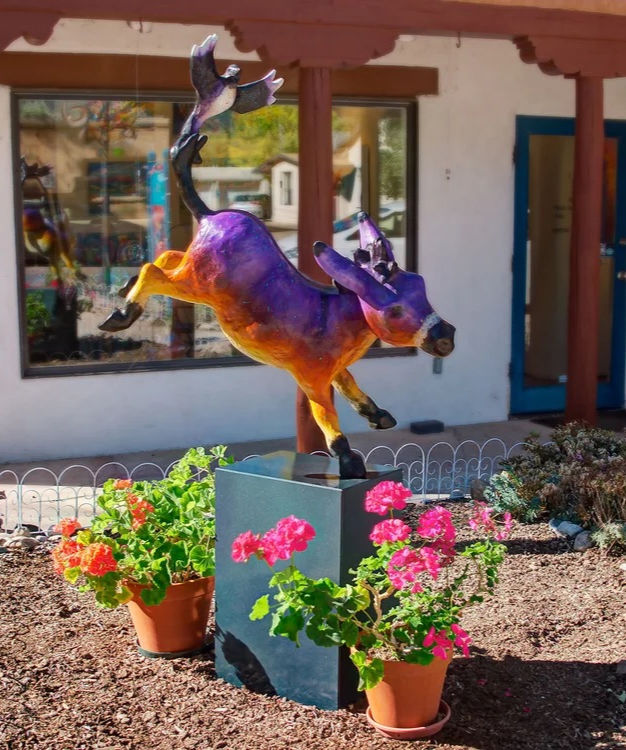
Colorful sculpture of a purple and orange animal with a bird on its tail, surrounded by potted pink flowers in a garden setting by artist Barbara Meilke Fine Art.
A vibrant sculpture titled "Hijinks Life-size" is prominently featured in front of Barbara Meikle Fine Art Gallery in Santa Fe, New Mexico.

Barbara Meikle:  My gallery is a wonderful place to find original work, with lots of color, emotion, and love. I’m often there painting or sculpting, so you can see an artist actually working, which is come to be a rare thing. we also have  live animal events several times a year, where I have donkeys and birds of prey, come to the Gallery from the different rescues that we support, so I paint them as they pose, while we help them raise money.


EquuStyle:  For 19 years, you have been raising money through the sale of your artwork for horse, donkey, and wildlife rescues across the country, in the region, and in the state of New Mexico. Is this one of the more gratifying aspects of working as an artist?


Barbara Meikle:  Yes! It’s always been easy for me to sell my work because I seem to love to paint and sculpt the things that other people love as well. So be able to give some of that back, to the animals that have inspired me throughout my career, just makes my work more meaningful, not only to me, but to people that collected as well.


In the picturesque landscape of Colorado, Richard Rodriguez embarks on a heartfelt artistic journey that combines his passion for horses with a commitment to capturing the essence of rescued horses that have suffered traumas.


An accomplished architect, Richard Rodriguez made the bold decision to follow his heart to become a full-time artist after after completing an enriching program at the Art Students League of Denver. His background in architecture gives him a distinctive viewpoint on form, space, and structure, which he now channels into his art. Employing brushes, palette knives, scrapers, and squeegees with oil paints, Richard crafts abstract shapes blended with realism on canvas or hardwood panels.

"In my paintings, I navigate the space between memories and dreams. Lines within the artworks represent the creases found in vintage photographs."

Richard contends, "Horses have often carried symbolic weight representing power, speed, strength, and even freedom. Yet in modern art they’ve appeared less frequently." For him it is essential to revitalize the portrayal of horses, especially within the context of equine fine art. By showcasing their grace and strength, he hopes to remind viewers of these creatures' longstanding significance and the stories they tell.


An oil painting titled "In Balance" by Richard Rodriguez of three brown rescued horses standing close together against an abstract, colorful background. They're facing slightly different directions.
"IN BALANCE" 36 x 48 OIL BY RICHARD RODRIGUEZ

At the Phippen Museum's 51st Annual Western Art Show and Sale, Richard Rodriguez was honored to be awarded the George Phippen Memorial Foundation Award for his 36 x 48 oil painting titled "In Balance."


A Personal Connection to Rescue


Richard's bond with horses is deeply personal. He adopted two of his three of his horses from the Colorado Horse Rescue (CHR). Possessing a profound admiration and affection for horses, Richard felt compelled to investigate the potential of capturing their essence through the lens of modern art.


While exploring the concept of using the rescued horses at CHR as subjects in his new body of work, Richard found himself wondering — "Does a horse that has been through the traumatic process of rescue lose its symbolic power to inspire?” This question not only reflects on the horses’ past hardships but also emphasizes their potential for transformation and the beauty they can embody in the present.


He also considered, "Can I capture the essence of these horses in their new surroundings and return their natural dignity through modern painting?" 


On a bright afternoon, Richard visited his friend Megan Goheen at Colorado Horse Rescue. The peaceful setting of CHR served as the perfect backdrop for his artistic exploration. This serene environment not only provided him with a picturesque landscape to inspire his creativity but also allowed him to immerse himself in the profound stories of the rescued horses that called this place home.

Abstract painting of a brown and white horse with a black mane on a textured background with the title "Painted" by fine artist and advocate Richard Rodriguez. Neutral tones with splashes of red and black.
"Painted" Oil on Canvas 8" x 8"

"Does a horse that has been through the traumatic process of rescue lose its symbolic power to inspire?”

Richard spent time observing, taking photos, and silently bond with the herd. Instead of brokenness, he found resilience. Instead of despair, he saw peace. Horses of various ages, breeds, and backgrounds were finding safety, comfort, and strength in each other.


Observing the horses interact was enlightening. Each group represented unique relationships, showcasing how the horses comforted each other as they adapted to their new lives. Regardless of breed or age, these animals found joy in simple moments of play, eating, and resting together. Creating art becomes an act of recognition, with each piece serving as a tribute to their ability to inspire and uplift.


"Shadows" Oil on Canvas 12" x 24"


Creating a Visual Legacy


With newfound inspiration from that day, Richard set out to create a vibrant body of work. His goal extends beyond simply painting horses; he strives to convey the emotional journeys he witnessed. His art serves as a reminder that, while the past may shape their experiences, it does not define their worth or potential for joy. Each brushstroke expresses the dignity, spirit, and beauty of these remarkable animals.


His deep engagement with the rescued horses enabled him to infuse each canvas with authenticity and depth, ensuring that each piece resonates with the viewer on multiple levels.


Richard understands that equine fine art has the potential to reshape public perceptions of rescue horses, presenting them as symbols of hope and strength. By sharing their stories, he hopes to foster a culture in which every horse is honored and offered the chance to thrive.


Stories of Rescue on Canvas: Artist Richard Rodriguez Paints Colorado Horse Rescue’s Horses

Honoring the Spirit of Rescue Horses


In this recent collaboration with Colorado Horse Rescue, Richard has created a dramatic series of paintings that acknowledge the vibrant lives of these horses today rather than just their past traumas. This perspective is crucial, as these works shift the narrative from one of suffering to one of resilience and vitality. Ultimately, Richard’s artistic vision is not just about depicting horses; it is about celebrating the vibrant lives they lead today, reminding us all of the beauty that can emerge from adversity.


"Copper Patina is an oil painting by artist and equine advocate Richard Rodriguez of a brown horse walking with its reflection below. Abstract pastel background with green, white, and pink hues. Energetic mood.
"Copper Patina" Oil on Canvas 36" x 24"

Throughout this collection, he captures the essence of their spirit, showcasing their playful nature, their grace in movement, and the bond they share with humans and their environment. Richard aspires for his work to resonate with advocates for horse rescue and collectors of equine fine art alike. By weaving the stories of each horse into his art, he reinforces the notion that every life holds value—regardless of past experiences.


In exhibitions and galleries, Richard’s works invite audiences to reflect on their own perceptions of horses and, by extension, all animals. He hopes to inspire a greater appreciation for the emotional lives of these beings, fostering empathy and encouraging a more humane approach to how society views and treats them.


Future Aspirations


Richard envisions his artistic journey as more than an individual project; it’s a movement aimed at raising awareness about the importance of rescue horses. Many of these horses carry emotional scars, yet those very scars tell powerful stories of resilience and survival.


By sharing these narratives through his art, Richard invites viewers to empathize with the horses' journeys. Each painting serves as a powerful reminder of the collective effort required by advocates to improve the quality of life for these majestic animals.


Final Thoughts on Richard Rodriguez's Mission


In a world often oblivious to the struggles behind closed doors, Richard’s mission provides a fresh perspective filled with hope. By portraying the essence of rescue horses, he preserves their stories and transforms them into symbols of strength and resilience. It is vital that we collectively honor these animals, ensuring that each horse is valued and given a chance to thrive, regardless of its history.


Art Shows & Events


COLORADO GOVERNOR'S ART SHOW

5/3/2025 - 6/14/2025

Loveland Museum

503 N Lincoln AveLoveland, Colorado 80537


PHIPPEN MUSEUM WESTERN ART 51ST ANNUAL SHOW & SALE 

5/24/2025 - 5/26/2025

120 S. Cortez Street

Prescott, Arizona


BROADMOOR ART EXPERIENCE - Live Painting and Sculpting

7/19/2025 - 7/20/2025

Broadmoor

Hotel1 Lake Ave.

Colorado Springs, Colorado 80906


ART ASSOCIATION OF JACKSON ARTS FESTIVAL

7/26/2025 - 7/28/2025

240 S Glenwood St,

Jackson, WY 83001


THE CAWDREY GALLERY

Opening Night Reception: 8/7/2025  

206 Lupfer Avenue Unit 102

Whitefish, MT 59937


ARTS STUDENTS LEAGUE OF DENVER -SUMMER ART MARKET

8/24/2025 - 8/25/2025

200 Grant St.

Denver, CO 80203

Tickets go on sale August 1. Purchase tickets in advance to save time at entry day-of.


ST LOUIS ART FAIR

9/05/2025 - 9/07/2025

225 S Meramec Ave #105

Clayton, MO 63105


COORS WESTERN ART "YOUNG GUNS ART SHOW"

12/18/2025

National Western Complex

4655 N. Humbolt St.

Denver, CO 80216


All images Copyright Richard Rodriguez and rmrstudio.net -all rights reserved. Cannot be reproduced for any purpose without permission from Richard Rodriguez and rmrstudio.net


Subscribe for equine art & advocacy

Subscribe today and receive a quarterly email to inform you about the upcoming

digital issue of EquuStyle Art & Advocacy Magazine.

Share via

© Copyright Protected

EquuStyle Magazine ©2023-2026 EquuStyle.com All rights reserved.

Privacy Policy

bottom of page