top of page

Magazine Articles

Writer: Patricia Miller
Patricia Miller
19 hours ago
6 min read


America’s wild horses and burros do not need another cycle of crisis. They need a modern management system, one that brings science, welfare, culture and collaboration together to keep them wild.


This summer, above the limestone and gold of Rockefeller Center, wild horses ran through the heart of Manhattan.


Woman in denim holds a blue-orange scarf in a grassy mountain meadow with horses grazing in the background.
Designer Chloé Gosselin's hand-painted flag titled "Freedom in the Wild Light"

They appeared not in flesh, but in silk, a herd moving beneath a deep Nevada sky on a flag hand-painted by designer Chloé Gosselin. Titled Freedom in the Wild Light, the work was created for Vogue and the Council of Fashion Designers of America’s United Flags of Fashion, presented with

America250. The horses were drawn from a photograph Gosselin made while visiting Nevada’s Fish Springs herd; the lead horse was inspired by her own horse, Milo. Beadwork created by the family of Ronda Kauk, a member of the Utu Utu Gwaitu Paiute Tribe and a guardian of the Mono Lake horses, replaced the familiar state star with an Indigenous North Star, a symbol of guidance and hope.


Nearby, designer, equestrian and American Wild Horse Conservation Board Member Jenni Kayne offered her own meditation on Nevada: shifting light, mountains, warmth and the quiet beauty of the Western landscape. Together, these works placed the wildness of the West inside one of America’s most visible cultural spaces.


The image was beautiful but it also raised an uncomfortable question:What does it mean to celebrate the wild horse as an emblem of freedom while continuing to manage these animals through a system built primarily around removing that freedom?


The American promise for wild horses and burros


In 1971, Congress unanimously passed the Wild Free-Roaming Horses and Burros Act, declaring these animals “living symbols of the historic and pioneer spirit of the West.” The law entrusted the Bureau of Land Management and the U.S. Forest Service with their protection on designated public lands.


More than half a century later, that promise remains unfinished.

Two wild horses, one white and one brown, stand in a metal trailer behind gray bars after being rounded up by the Bureau of Land Management.
The Wild Free-Roaming Horses and Burros Act of 1971 specifically states "It is the policy of Congress that wild free-roaming horses and burros shall be protected from capture, branding, harassment, or death; and to accomplish this they are to be considered in the area where presently found, as an integral part of the natural system of the public lands."

The BLM estimates that 85,466 wild horses and burros lived on the public lands it manages as of March 2026. They occupy a fraction of the agency’s wider estate, approximately 25.5 million acres across ten Western states, lands also asked to accommodate livestock grazing, energy and mineral development, recreation, wildlife habitat and increasingly severe drought and wildfire.


Managing populations is essential but how do we do it while keeping horses on the range and still protecting the lands they need to thrive?


The dominant federal response has become a costly, ineffective loop: gather, remove and hold.

As of May 2026, 58,025 federally protected wild horses and burros were living in off-range corrals and pastures. In fiscal year 2024, the federal government spent $101 million on off-range holding, 66 percent of total Wild Horse and Burro Program expenditures. At that pace, the country is maintaining a billion-dollar-per-decade holding system while leaving too little funding and capacity for the on-range work that could reduce the need for removals.


  • Wild horses in a holding pen with no room to move. Click on photo to learn how to help now.
    Wild horses in a holding pen with no room to move. Click on photo to learn how to help now.
  • Distressed wild stallions sparring after BLM roundup. Click on image to learn how you can help now.
    Distressed wild stallions sparring after BLM roundup. Click on image to learn how you can help now.
  • America's wild horses deserve freedom, not captivity or slaughter. Click on photo to help today.
    America's wild horses deserve freedom, not captivity or slaughter. Click on photo to help today.

All images © Darlene Smith for American Wild Horse Conservation


This is not the wildlife-management system most Americans imagine when they hear the word protected. Nor is it fiscally sustainable.


The answer, however, is not to abandon management. It is to modernize it.


From crisis response to management


For years, the public conversation has been framed as a choice between two extremes: remove horses or do nothing. It is a false choice.


A modern model begins before roundups are scheduled and long before helicopters take off.  It combines accurate and transparent population data, fertility control, habitat and water stewardship, genetic monitoring, migration and movement planning, public safety measures, and accountable, multi-year plans tailored to each herd and landscape. When removal is truly necessary, it should be limited, humane and paired with responsible placement—not treated as the first or only tool.


We have the tools but we have not had the will to implement them at a scale large enough to make a meaningful difference.
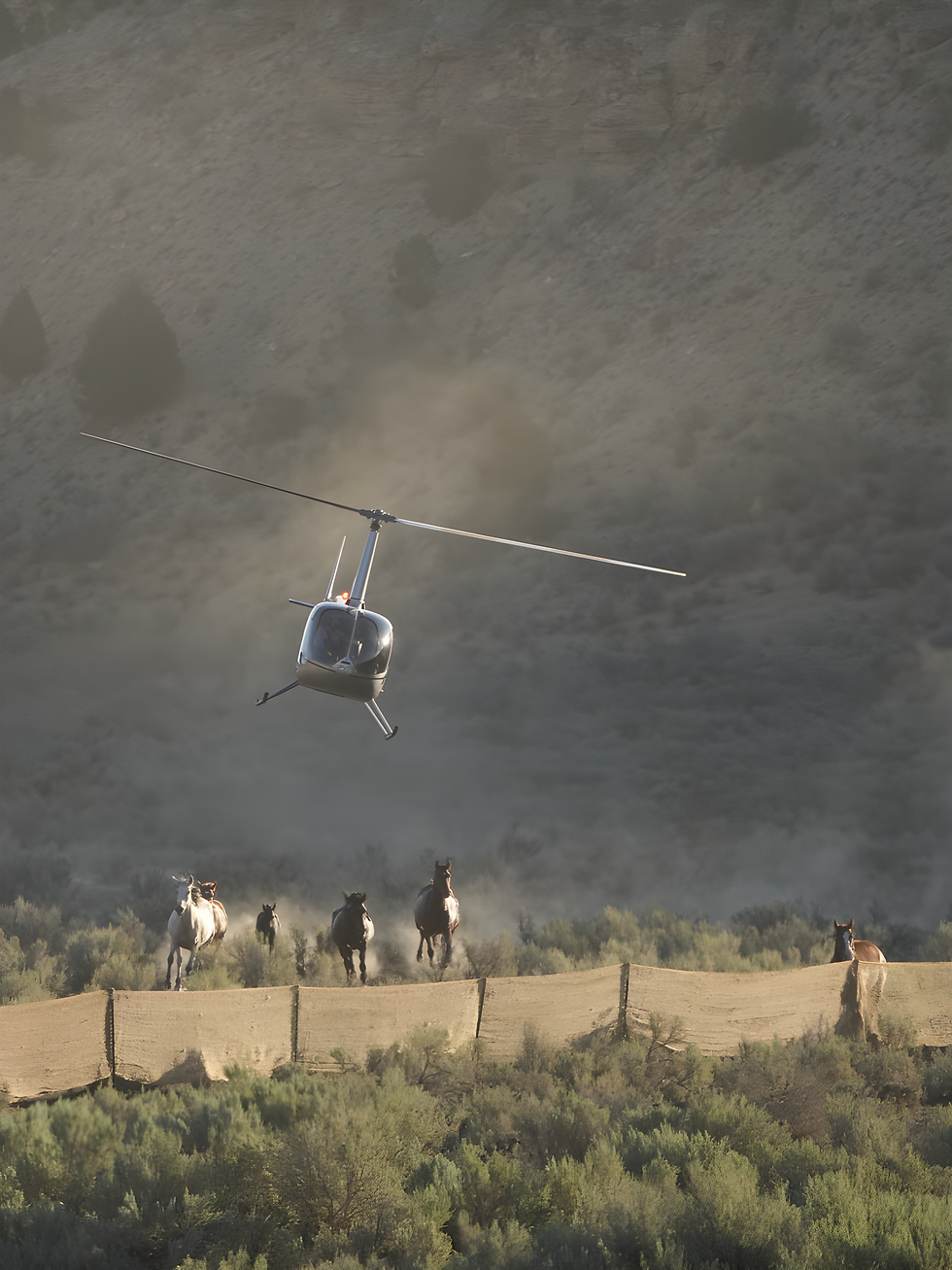

Helicopter flies low over a dusty hillside, chasing several wild horses into a trap behind a tan fence in a rugged pasture.
Wild horses being chased into a trap during a helicopter roundup. © Brian Clopp for AWHC

In Nevada’s Virginia Range, American Wild Horse Conservation operates the largest humane fertility-control program of its kind. The work is far more than delivering a vaccine by dart. It is a living management system: identifying individual horses, tracking mares and foals, training field teams, maintaining data, earning land access and returning season after season.


The results are measurable. From January through June 2026, the program documented 109 foals, compared with 494 during the same period in 2020, a 78 percent reduction. Across nearly 300,000 acres, the work has involved approximately 3,400 identified horses and collaboration among the State of Nevada, trained volunteers, landowners, local communities, conservation partners and businesses.


This is science at scale. It is also proof of something larger: humane management works when it is treated not as a pilot on the margins, but as infrastructure.


No single fertility-control method will fit every herd. Remote darting is practical where horses can be individually identified and approached safely; in more remote landscapes, treatment may need to occur during carefully planned gathers followed by release. Some places require water improvements, fencing changes, roadway mitigation or different technology altogether. Good management is adaptive by nature.


What matters is that the objective changes from removing the greatest possible number of animals to maintaining healthy, genetically viable herds on the range wherever possible.


Conservation as a shared practice


The future will not be built by government alone, or by advocacy alone.


It will require the BLM and Forest Service working alongside scientists, tribal communities, local advocates, ranchers, conservationists and the many people who share multiple-use public lands. It will require private partners willing to contribute technology, data systems, access, philanthropy and operational expertise. It will require lawmakers to fund prevention with the same seriousness that taxpayers are currently funding holding.


And it will require bridge builders.


Bridge building does not mean surrendering conviction. It means beginning with the shared truths that healthy horses need healthy land; taxpayers deserve an effective system; rural communities deserve to be heard; and federally protected animals deserve management worthy of that status. It means replacing a cycle of litigation, emergency and distrust with measurable objectives, transparent reporting and local partnerships that endure beyond a single administration or roundup schedule.
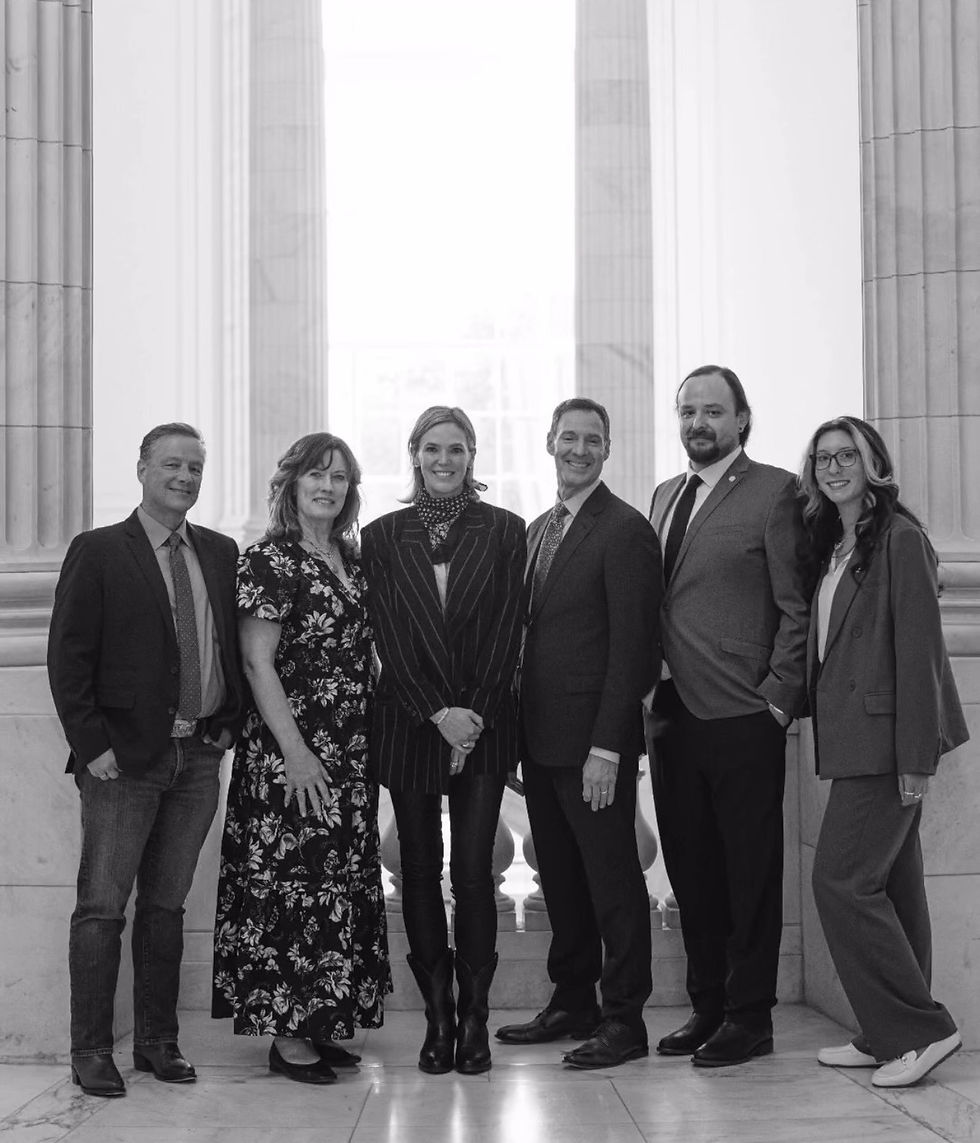

Six smiling members of the American Wild Horse Conservation team pose on Capitol Hill between tall columns in a black-and-white formal group portrait.
American Wild Horse Conservation Team on Capitol Hill working to protect and preserve America's wild horses and burros

At American Wild Horse Conservation, we have been expanding this work through on-range programs and partnerships from Nevada’s Virginia Range and Fish Springs to the  developed fertility-control partnership for Utah’s Cedar Mountain herd now run by Utah based organizations. We are bringing field evidence into conversations with agencies and Congress, and asking for appropriations that can move humane fertility control from exception to standard practice.


We are also showing up through art, fashion, film and photography because policy alone cannot carry the whole story.


Photography has always been essential to wild-horse protection. It reveals family bands, courtship, grief, play and survival, social lives that disappear when horses become numbers in a federal spreadsheet. It also serves as witness during removals, making animal welfare visible to the public. Film can bring the range into rooms far from the West. Art can cross an ideological divide before an argument ever begins. Fashion can place a wild horse over Rockefeller Center and invite millions of people to ask what freedom looks like in practice.


These are not decorative additions to conservation. They are ways of restoring relationships.

We protect what we know. We fight for what we have learned to love. And sometimes beauty is the first door through which understanding enters.


What we choose to leave wild


Wild horses and burros are not separate from the biodiversity of the West. They live within intricate landscapes of sagebrush, native grasses, migration corridors, springs, birds and other wildlife. Their future depends on managing the whole, not reducing nature to competing columns on a balance sheet.


As America marks 250 years, we are being asked to consider not only what we inherited, but what we intend to pass forward.

The wild horse helped carry this country into being. The burro carried people, water and possibility through some of its most unforgiving landscapes. Today, they ask something different of us: not labor, but leadership.


We know the old system is broken. We know the cost of continuing it. And we know a better model already exists in the quiet, disciplined work of counting, treating, monitoring and returning; in public and private partners sharing responsibility; in science made operational; and in culture reminding us why any of it matters.


The next chapter of wild horse conservation will not be written by choosing between compassion and management. It will be written by insisting upon both.


We built this country with horses. The least we can do is leave them a horizon.


Help us keep this momentum going and protect even more wild horses and burros. Donate today: https://bit.ly/44INYlE

EquuStyle Magazine thanks Patricia Miller, Executive Director, American Wild Horse Conservation for writing an excellent article and sharing photographs. Our sincere thanks to every supporter of AWHC who advocates for the protection and preservation of America's wild horses and burros on our public lands.


All images Copyright American Wild Horse Conservation -all rights reserved. Cannot be reproduced for any purpose without permission from the photographer or American Wild Horse Conservation.


Updated: Sep 16

Discovering the World of Donkeys: An Artistic Journey


EquuStyle: How did you become interested in painting and sculpting donkeys?


Barbara Meikle: I was born a horse lover. My journey into the world of donkeys began when I had to care for a pair of riding mules. Their intelligence and unique personalities captivated me. A visit to a donkey rescue in Colorado, Longhopes, sealed the deal. I wanted to paint them just as much as I painted horses.


Two colorful donkeys nuzzle affectionately in a vibrant, abstract painting with bold brushstrokes and a turquoise background.
Playful and vibrant, these colorful burros exude an irresistible charm, capturing hearts with their lively energy. 'Getting a Bit Rowdy' Oil on canvas 16'h x 16'w

Capturing Individuality in Art


EquuStyle: Do you aim to portray the individual personality of each animal, or a more general 'essence' of a donkey?


Barbara Meikle: I strive to do a little of both. There are individual traits, like the length of their coat or the dorsal stripe. Yet, there’s also a universal quality—the gentle eye and the tilt of the ear when you’ve caught their attention.


EquuStyle: How does your relationship with donkeys influence the way you portray them?


Barbara Meikle: I focus on the physical differences between horses and donkeys. This distinction is crucial. The angle of the head, the straightness of the back, and the smooth coat versus shaggy fur all matter. My love for them allows me to give them big brown eyes and a mischievous expression, capturing their charm.


Evoking Emotion Through Art


EquuStyle: What feeling or mood do you hope a viewer experiences when looking at your paintings and sculptures?


Barbara Meikle: I hope to evoke happiness! I want viewers to feel joy and beauty, simply absorbing the energy of these wonderful creatures.


Exploring Donkey Artistry: Techniques in Paint and Clay


EquuStyle: How do you think the medium (painting vs. sculpture) changes the way you represent donkeys?


Barbara Meikle: Paintings allow me to be experimental, playing with abstract ideas of color, texture, and movement. Sculpture, however, keeps me grounded in three dimensions. I must get the proportions right from every angle while making it interesting.


Two colorful donkeys in a vibrant, abstract setting. Bright strokes of blue, orange, and pink create a lively, energetic mood.
Stepping Into The Sun, oil on canvas, 30”h x 30”w

EquuStyle: How do you apply impressionist techniques, such as visible brushstrokes and an emphasis on light and movement, to capture the essence of a donkey?


Barbara Meikle: I start with a brush to sketch the subject, then use a palette knife to apply thicker layers of paint. I mix colors and values, using brights and pastels to show movement by losing edges. I often overshoot the color, allowing the background to define the donkey's image.


EquuStyle: Which visual elements—color, light, texture, or form—do you feel take priority in your work, and how does that choice impact the final painting?


Barbara Meikle: All these elements are vital. Color is expressive and emotional; it reflects how I feel about the animal. Light anchors the painting in reality. Texture builds character, while form ensures I accurately represent the donkey or horse, even if I take creative liberties.


Influences, Creative Process, and Challenges


EquuStyle: Are there any other artists, within the impressionist movement or wildlife art community, who have significantly influenced your work?


Barbara Meikle: Many French impressionists, like Monet, Pissarro, and Sisley, have inspired me. Outliers like Manet, van Gogh, and Toulouse-Lautrec also offer valuable insights into subject matter, color, and the artistic process.


Five colorful donkeys in a vibrant, abstract painting. Bright hues of blue, pink, orange, and green create a lively, energetic mood.
These jennies are waiting oh so patiently for their midday meal! 'The Ladies Who Lunch.' Oil on canvas, 24”h x 12”w

EquuStyle: What is your process for creating the work? Do you use photo references, live models, or memory and imagination?


Barbara Meikle: I love painting from life, or "en plein air." I also use photographs from my travels to places like France and Africa. After nearly 50 years of painting and drawing animals, I rely heavily on my imagination.


EquuStyle: What technical challenges did you face when capturing the form or texture (e.g., fur, muscle, movement) of a donkey, especially in sculpture?


Barbara Meikle: Sculpture is a long game. I first create an armature, or skeleton, for the piece, then cover it in clay. It's a constant process of tweaking. I must consider the donkey's confirmation, the length of its ears, and how I place its feet. While I can finish a painting in days, a sculpture can take weeks or months. Once I hand it off to the mold maker, no more changes can be made.


Emotions and Ideas in Art


EquuStyle: What emotions or ideas do you hope viewers take away from your work?


Barbara Meikle: I hope people learn to enjoy the donkeys, horses, and other creatures I paint and sculpt. I want them to see these animals as individuals, just like us.


Passions Driving Her Professional Journey


EquuStyle: How do your interests outside of art fuel your artwork?


Barbara Meikle: I ride horses regularly, which keeps me thinking about how I would paint them. Trail riding exposes me to beautiful landscapes, inspiring my art. Visiting donkey rescues also sparks my creativity as I interact with the animals.


Smiling woman with curly blonde hair, wearing a turquoise necklace and plaid shirt. Bright abstract painting in vibrant yellow and red behind her.
Fine artist Barbara Meikle stands in front of her vibrant abstract painting, wearing a turquoise necklace and a colorful plaid shirt, embodying her creative spirit.

EquuStyle: What do you like most about being an artist?


Barbara Meikle: I love everything about being an artist—the challenges, the freedom, and the joy of creating something unique. I also appreciate being able to earn a living while supporting rescues that I believe in.


EquuStyle: In what ways does living and owning a gallery in Santa Fe impact your art?


Barbara Meikle: Santa Fe is the third-largest art market in the country, after New York City and Los Angeles. Many people come here to collect art. I like to say that New York is about investment, Los Angeles is about trends, and Santa Fe is about heart. People come from all over the world to find something they want to take home and remember their visit to our beautiful city.


Harnessing Creativity for Compassion: Barbara Meikle's Art Supporting Animal Rescues


EquuStyle: What would you like art enthusiasts to know about Barbara Meikle Fine Art?


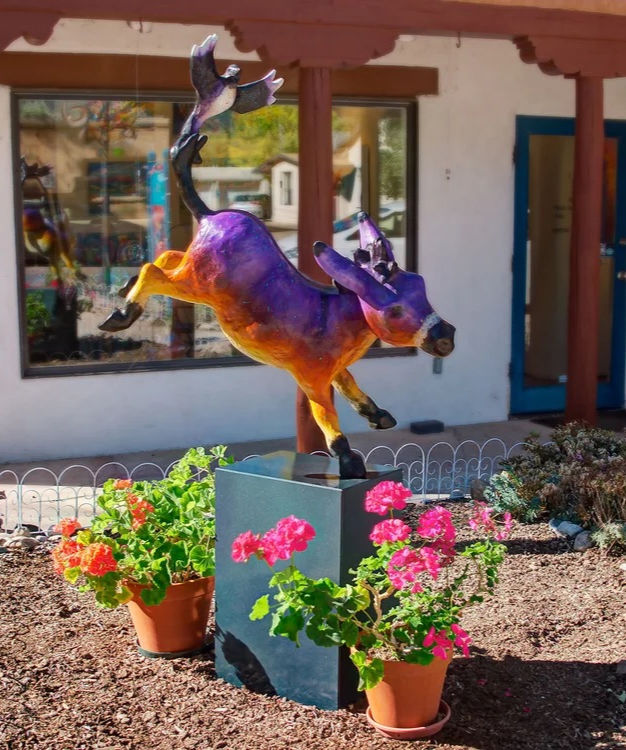
Colorful sculpture of a purple and orange animal with a bird on its tail, surrounded by potted pink flowers in a garden setting by artist Barbara Meilke Fine Art.
A vibrant sculpture titled 'Hijinks Life-size' is prominently featured in front of Barbara Meikle Fine Art Gallery in Santa Fe, New Mexico.

https://www.meiklefineart.com/artworks/barbarameikle/oil-paintings/donkeysBarbara Meikle: My gallery is a wonderful place to find original work filled with color, emotion, and love. I often paint or sculpt on-site, which is rare these days. We also host live animal events several times a year, featuring donkeys and birds of prey from rescues we support. I paint them as they pose, helping to raise money for these organizations.


EquuStyle: For 19 years, you have been raising money through the sale of your artwork for horse, donkey, and wildlife rescues across the country, in the region, and in the state of New Mexico. Is this one of the more gratifying aspects of working as an artist?


Barbara Meikle: Absolutely! Selling my work has always been easy because I paint and sculpt what people love. Giving back to the animals that inspire me makes my work more meaningful, not just for me but for those who collect it as well.


The Heart of Donkey Artistry


In the world of art, every brushstroke tells a story. Each sculpture captures a moment in time. My work aims to celebrate the unique charm of donkeys and their kin. I want to share their joy and spirit with the world.


As I paint, I often reflect on the bond we share with these animals. They teach us patience, kindness, and understanding. When I create, I hope to inspire others to appreciate these beautiful creatures.


Art has a way of connecting us. It transcends words and speaks to our hearts. Through my work, I hope to foster a deeper appreciation for donkeys and the important role they play in our lives.


A Call to Action for Animal Welfare


I invite you to join me in supporting animal welfare. Whether through art, volunteering, or simply spreading awareness, every effort counts. Together, we can make a difference in the lives of donkeys and other animals in need.


Explore my work and learn more about the rescues I support. Your passion for art can help create a brighter future for these wonderful creatures.


For more information, visit Meikle Fine Art or follow my journey on Instagram and Facebook.


Film crew recording an elderly former racehorse trainer wearing a cowboy hat is seated outdoors near stables. Equipment and film crew members surround him, capturing audio and video during an interview about the film "Eddie's Turn".
Writer/Director Annika Hylmö and crew on the set of the upcoming film Eddie's Turn. Photo: Ashley Covington

Swedish filmmaker Annika Hylmö had just completed her first short film, the film festival award-winning comedy Dr. Penelope, was enjoying the critical acclaim and looking forward to pre-production on her next two projects when the COVID pandemic in 2020 shut down the film industry. Gone were the movie theatre audiences and with them the funding – donations and grants – that independent filmmakers rely on. 


“It was very tough,” said Hylmö, who has been living in California for over 20 years. “I wrote scripts and made short films for many years, with the goal to make narrative films, something I’ve been working toward my whole career.” The shut-down left everything open-ended, with no clue how long it would last. Discouraged, worried about her career and her finances, Hylmö started experiencing anxiety and knew she needed to take care of her mental health.


Swedish filmmaker Annika Hylmö riding a white horse named Eddie in a forest. She wears a brown top and helmet, and the horse has a maroon bridle. Green trees surround them.
Hylmö and Eddie on one of their afternoon jaunts. "I try to ride at least three times each week." Photo: Ashley Covington

As a youngster, the one activity that soothed her more than anything else was riding. As often as she could, Annika would make her way over to the stable and take one of the horses for a ride. “I realized I wanted to start riding again,” Hylmö said, who never formally quit riding but between getting her master's degree and her Ph. D in Communications she didn’t have time for something she once thought of as a hobby.


It took only a couple of weeks of riding regularly that made Hylmö realize this was much, much more than a hobby. Annika got back into riding three days a week, exploring new trails and vistas, and getting to know Eddie, the 10-year-old white gelding she rode regularly. Eddie had been a successful racehorse, who competed at Santa Anita and Del Mar racetracks before an injury forced his retirement. 


Eddie, who would soon be Annika’s horse, did more for Hylmö’s mental health than she could have imagined. “I experienced such a dramatic change in the way I felt about myself and about my life when I was around him that I wanted to learn what this was about,” she said, leading her to discovery a therapeutic school for treating anxiety disorders and trauma called equine therapy, where the presence of a horse in the therapy sessions give clients a sense of security as they reveal their feelings. She learned that former racehorses were among the best equine therapy partners, due to their temperament and self-discipline. “I became aware of this incredibly symbiotic relationship happening across species,” Hylmö said. “We have the capacity – and the desire – to help each other, to make both of us better.”


  • Swedish filmmaker Annika Hylmö and Eddie a retired racehorse and the star of the film Eddie’s Turn share a happy moment.
    Facetime for Eddie and Annika
  • Swedish filmmaker Annika Hylmö and Eddie a retired racehorse and the star of the film Eddie’s Turn share a happy moment.
    Annika share a close bond Eddie
  • Swedish filmmaker Annika Hylmö and Eddie a retired racehorse and the star of the film Eddie’s Turn share a happy moment.
    Eddie and Annika share a sweet moment

All photos of Annika Hylmö and Eddie by Ashly Covington


Hylmö believes the narrative story-telling format will resonate more powerfully with audiences because of the emotional nature of the horse and human connection. “In a documentary, you can tell the audience what the problem is you’re trying to solve,” Hylmö said. “In a scripted story you have to make them feel it.”  Films like Seabiscuit, Secretariat and Robert Redford’s classic The Horse Whisperer, have gone down in history as forever changing the way humans understand horses and, how they understand us. Steven Spielberg’s War Horse gave us a closer look at the inner life of horses and the trust that is so vital to any meaningful horse/human dynamic.


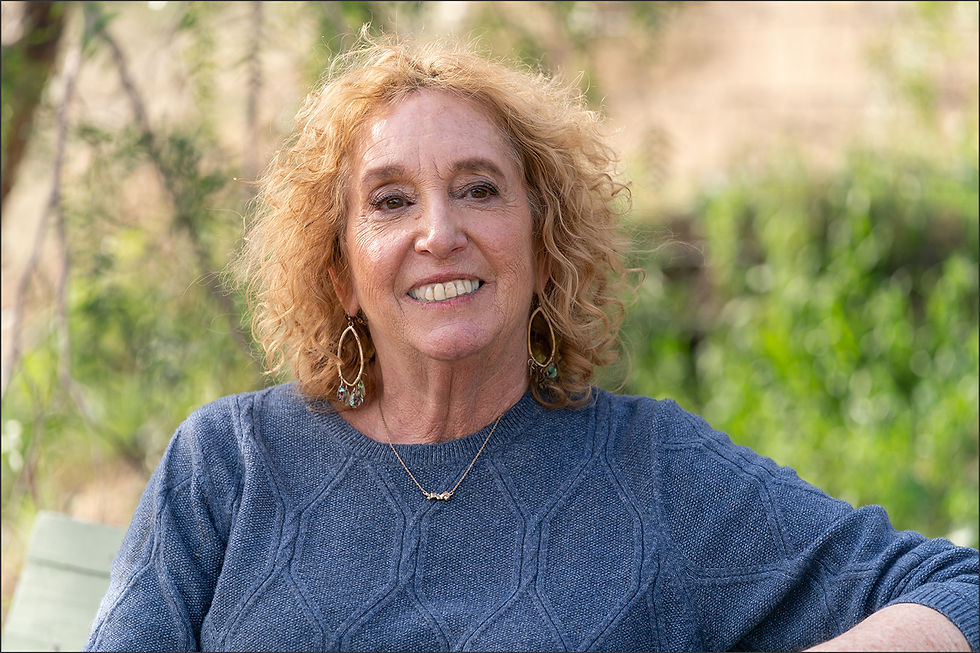
Smiling woman with curly hair in a blue sweater sits outdoors against a blurred green background, conveying a cheerful and relaxed mood.
Eddie's Turn Producer Betsy Pollock being interviewed about the challenges of bringing a short film to life. Photo: Ashly Covington

With her mission clear, Hylmö turned to her good friend and colleague, Academy Award®-winning producer Betsy Pollock, who was AFI’s head of production for 16 years. Together they produced a budget that included pre-production, principal photography and post-production, horse wrangling, ranch and stable rentals, cast and crew. One of Hylmö’s first hires was Bergitte Jorgensen of Bixi Communications to create and support an online and social media presence for Eddie’s Turn. “Fundraising for independent projects has always been difficult,” stated Pollock, “and has become even more so as the industry has contracted over the past few of years, as all independent filmmakers know. Fortunately, there are organizations like our fiscal sponsor, Film Independent, that partner with indie filmmakers to provide support, networking opportunities, outreach, etc.”


  • On the film set of "Eddie's Turn" Producer Pollock and Writer/Director Hylmö discuss a story point during rehearsal. Pollock and Hylmö discuss a story point during rehearsal. Photo by Ashly Covington
    Pollock and Hylmö discuss a story point during rehearsal. (Photo: Ashly Covington)
  • Rolf Gustafsson previous owner of retired racehorse Eddie on the movie set at Red Rock Riding Ranch. (Photo: Ashley Covington)
    Rolf Gustafsson previous owner of Eddie at Red Rock Riding Ranch. (Photo: Ashley Covington)
  • Annika Hylmö and Eddie at Red Rock Riding Ranch is located in the majestic hills north of Los Angeles. (Photo: Ashley Covington)
    Red Rock Riding Ranch is located in the majestic hills north of Los Angeles. Photo: Ashley Covington
  • Hylmö gives Eddie his post-workout grooming. (Photo: Ashley Covington)
    Hylmö gives Eddie his post-workout grooming. (Photo: Ashley Covington)

All photos of Annika Hylmö and Eddie by Ashly Covington


Annika and her team are investing in a concentrated social media and outreach campaign for Fall 2025 to support the EquuStyle article’s publication with racetracks, horse owners, breeding farms, horse clubs and more. “We believe that Eddie’s Turn can have social impact and make a difference in our world,” said Hylmö. “It’s our intention once the film is complete and we’ve finished our festival run to offer Eddie’s Turn as a fundraising tool to off-the-track thoroughbred communities and an educational tool for equine therapy centers.”


“We’re made aware every day that there’s a mental heath crisis out there,” Annika said thoughtfully, “and a need for more affordable care. It is our hope that Eddie’s Turn will help build awareness of Equine Therapy and its value, for people looking for help and for on-and-off-track racehorse owners as well.”


EquuStyle Magazine expresses gratitude to Pamela Rodi for her captivating article on the forthcoming film Eddie's Turn and Ashly Covington's photography. We extend our heartfelt thanks to all those involved in the creation of Eddie's Turn, particularly filmmakers Annika Hylmö and Producer Betsy Pollock, who aim to highlight the advantages of equine-assisted therapy for people of all backgrounds.


All images are copyrighted by Ashly Covington and Eddie's Turn Movie - all rights reserved. Reproduction for any purpose is prohibited without permission from Ashly Covington and Eddie's Turn Movie.


Please read EquuStyle Magazine's Disclaimer https://www.equustyle.com/disclaimer 


Subscribe for equine art & advocacy

Subscribe today and receive a quarterly email to inform you about the upcoming

digital issue of EquuStyle Art & Advocacy Magazine.

Share via

© Copyright Protected

EquuStyle Magazine ©2023-2026 EquuStyle.com All rights reserved.

Privacy Policy

bottom of page