top of page

Magazine Articles

Two donkeys stand in a pasture at sunset, facing distant hills. The sky glows orange. Rancho Burro Donkey Sanctuary logo is visible.
Rescued donkeys enjoy a peaceful sunset at Rancho Burro Donkey Sanctuary, surrounded by rolling hills and tranquility.

Rancho Burro Donkey Sanctuary, established in 2016 by Jim and Carlen Eckford, is located in San Luis Obispo on 46 acres, with a barn built specifically to accommodate donkeys and mules who need medical and physical rehabilitation. The new sanctuary offers ample space for the rescued donkeys and mules to roam, graze, exercise, and heal.


The donkeys and mules come from abuse situations. Some have been abandoned, abused, wounded, or in the slaughter pipeline and rescued from kill pens.


Three donkeys stand on a sandy ground under a cloudy sky at Rancho Burro Donkey Sanctuary. Two face forward; one walks away. Blue buckets nearby.
Mable, Smokey & Mayday

The sanctuary provides all medical care as needed, as well as mental and physical rehabilitation with lots of love and patience. Each new arrival receives a full health assessment, including blood tests, dental care, crucial hoof care, and a nutritional plan tailored to each individual.


The focus is on gentle handling and creating a calm environment, allowing the donkeys to heal and learn to trust again as they bond with the caregivers as well as the rest of the bonded herd. 


Donkeys and Mules love people, and humor and playfulness are also important in the agenda.


A Healing Space


The heart of our new sanctuary's commitment to healing and education lies in our purpose-built barn. Our barn features a medical room designed to meet our needs, as well as those of veterinarians and the use of the classroom for community education.


This medical space is not just a room; it is a critical refuge where the road to recovery begins for our donkeys and mules who arrive often bearing the invisible scars of neglect. It provides our veterinarians a safe space for examinations, treatment, and dental work, ensuring that every procedure is carried out with the utmost care, comfort, and clinical precision.


Donkeys wear red and white gear in a clinic at Rancho Burro Donkey Sanctuary. People administer care with blue and red hats. Metal shelves and equipment in the background.
Veterinarians at the Rancho Burro Donkey Sanctuary provide individualized medical care, ensuring each donkey receives attention and comfort during treatment.

Meanwhile, the dedicated classroom transforms compassion into actionable knowledge, allowing us to host educational sessions that inspire our community and foster a lasting commitment to animal welfare.


Our barn is intended to care for wounded and injured donkeys and mules, as it provides a clean environment, in addition to special soft stall floors to help those with damaged hooves, injured, or arthritic joints in need of a safe place to rest. 


Close-ups of a donkey's mouth with overgrown teeth and hooves in poor condition. Brown dirt background. Rancho Burro Donkey Sanctuary logo visible.
Donkeys receive crucial dental and hoof care: addressing dental issues and providing specialized hoof support to treat laminitis effectively.

A Lifetime Home

Brown donkey with a bright blue halter peers through a metal fence at a sunny ranch. Background shows more donkeys. Rancho Burro Donkey Sanctuary logo visible.
Bella Luna peers through the fence at Rancho Burro Donkey Sanctuary, where she enjoys a life of care and kindness.

"The donkeys and mules are not available for adoption as many need specialized care daily. Also, most have been shuffled around and/or suffered trauma, and we choose not to expose them to yet another new and strange situation. They have become a family with the donkeys here and with us, and being the sensitive creatures they are, we do not feel it is right to place them in yet another home."


Private Educational Tours & Differently Enabled Visits


People observing donkeys in an outdoor sanctuary. Clear sky, hills in the background. Logo: Rancho Burro Donkey Sanctuary. Peaceful mood.
Visitors enjoy a sunny day interacting with rescued donkeys and mules at Rancho Burro Donkey Sanctuary.
A donkey nuzzles a smiling person in a wheelchair while another person stands beside them. Indoor setting, warm atmosphere at Rancho Burro Donkey Sanctuary.
A heartwarming moment as a rescued donkey gently greets a woman in a wheelchair, bringing joy to her day.

While Rancho Burro is not open to the general public, we feel a deep responsibility to share the profound peace and resilience of our rescued herd. We are honored to offer limited, donation-based private educational tours that provide a truly intimate, guided experience with our donkeys and mules. 
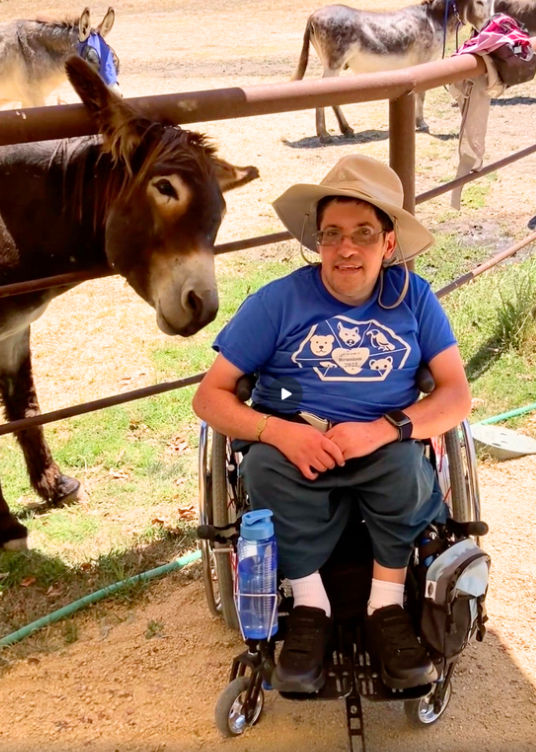

Man in wheelchair wearing a blue animal shirt and beige hat, smiling beside a donkey at Rancho Burro Donkey Sanctuary. Outdoor setting with more donkeys in the background.

A vital, heartfelt part of our mission is dedicated to providing specially tailored differently abled tours, ensuring that everyone, regardless of physical or cognitive ability, has the chance to forge a powerful connection with these gentle animals and experience the healing tranquility of the sanctuary.


Volunteers making a difference at Rancho Burro Donkey Sanctuary
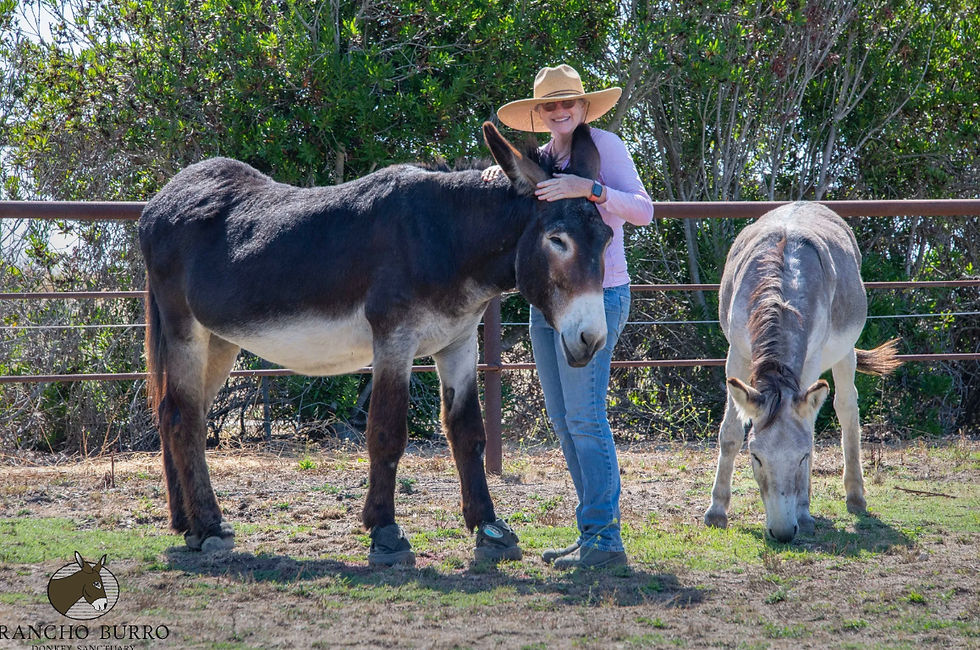
Woman in a hat smiles, embracing a dark brown donkey at Rancho Burro Donkey Sanctuary. Another donkey grazes nearby. Green foliage and fence in the background.
Volunteer Nancy DeRuchie shares a joyful moment with Bobo the donkey at Rancho Burro Donkey Sanctuary.

Rancho Burro Donkey Sanctuary is deeply dependent on the dedication of our volunteers, who provide the compassion and daily care essential for the herd's well-being. Their work includes feeding, grooming, and enrichment.


For safety, we require prior Equine experience for hands-on roles, though we also offer many non-equine opportunities to support our mission.


Community Support & Fundraising Events


The life-changing work at Rancho Burro is sustained by community compassion, channeled through our unique and heartfelt fundraising events. Events like our Annual Fundraising Gala, Painting Workshops, and Sanctuary Sound Journeys are vital gatherings that provide crucial funding. This support directly translates into the specialized care and comprehensive rehabilitation needed to ensure a peaceful, loving lifetime home for every donkey and mule we rescue.


A group at a fundraising event, outdoor evening, casual attire. A cowboy band performs inside, and a group displays artwork in a well-lit room at Rancho Burro Donkey Sanctuary.
Community members come together for an annual fundraising event where they enjoy live music. Participants in painting workshops display their artistic creations with pride to support a meaningful cause.

How You Can Help


As a dedicated nonprofit organization, Rancho Burro Donkey Sanctuary is powered solely by the compassion and incredible generosity of our supporters, allowing us to fulfill our mission of rescue, rehabilitation, and providing lifelong sanctuary to abused, abandoned, and neglected donkeys and mules.


Whether through crucial financial contributions, thoughtful legacy planning, or heartfelt gifts in kind, every form of donor support is the engine that fuels the sanctuary, making a lasting impact and ensuring we serve more donkeys and mules through rescue, comprehensive rehabilitation, and the promise of a peaceful, lifetime home.
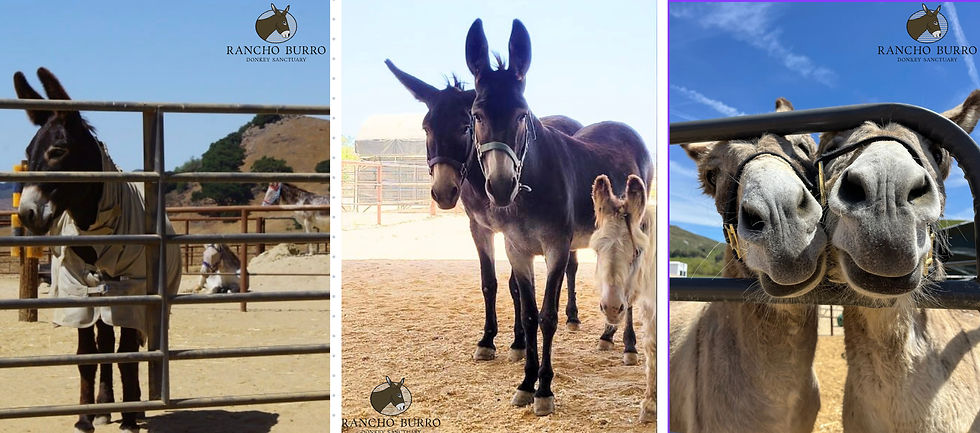


Three donkeys in a sunny, open pen, one peeking through a gate, two nuzzling closely. Blue sky and Rancho Burro Donkey Sanctuary logo visible.
Donkeys at Rancho Burro Sanctuary, with their endearing faces and curious nature, spread joy and warmth to everyone who visits.

Our mission is to rescue, rehabilitate, and give lifetime homes to abused, abandoned, and neglected donkeys and mules.  We strive to create positive change in our community through various initiatives and educational programs sharing the healing and goodness of donkeys.  

Stylized donkey head in profile within a striped circle, with text "Rancho Burro Donkey Sanctuary" below, on a white background.


Wild burros have roamed the American West for centuries, often misunderstood and undervalued. Yet, these hardy equines play a vital role in maintaining the balance of this unique ecosystem. Advocates for wild horses and burros emphasize the importance of keeping these animals wild, not only for their own survival but for the health of the environment they inhabit. This article explores the top five reasons why wild burros need to remain wild, highlighting their ecological contributions and the broader conservation efforts that support them.


Rescued burros at Skydog Ranch and Sanctuary make eye contact while standing in the sanctuary's open and natural environment. A black-and-white image captures the shadows and varied fur textures of a group of donkeys on a dirt path surrounded by trees.
Rescued wild burros at Skydog Ranch and Sanctuary Photo: WeAnimals.org

1. Wild Burros Help Maintain Plant Diversity


Wild burros graze selectively, which helps control the growth of certain invasive plant species. Their feeding habits promote a diverse plant community by preventing any one species from dominating the landscape. This selective grazing supports a variety of native plants, which in turn provides food and habitat for other wildlife.


For example, in areas where wild burros are present, native grasses and shrubs tend to flourish more than in regions where burros have been removed. This diversity is crucial for sustaining pollinators, small mammals, and birds that rely on a range of plants for survival.


2. They Support Water Access for Multiple Species


Wild burros are known as natural well-diggers. They use their hooves to dig into dry stream beds and arid soil, creating water holes that collect rainwater and groundwater. These water sources become critical for vertebrate species, including birds, reptiles, and mammals, especially during dry seasons.


By maintaining access to water in harsh environments, wild burros indirectly support the survival of many other species. This behavior highlights their role as ecosystem engineers, shaping the landscape in ways that benefit a broad range of animals.


Dr. Erick J. Lundgren is one of the top experts in the world on wild horse and burro ecology, with two peer-reviewed papers published in the highly prestigious journal Science. Dr. Lundgren and a team of researchers "detected 59 vertebrate species at equid wells, of which 57 were recorded drinking." In addition, the"results suggest that equids, even those that are introduced or feral, are able to buffer water availability, which may increase resilience to ongoing human-caused aridification."


3. Wild Burros Contribute to Soil Health


The movement and grazing patterns of wild burros help aerate the soil and distribute seeds across large areas. Their hooves break up compacted soil, allowing water to penetrate more easily and encouraging plant growth. Additionally, their droppings act as natural fertilizer, enriching the soil with nutrients.


By grazing on grasses, shrubs, and other plants, they contribute to the overall health of the landscape, preventing overgrowth and allowing for a diverse range of flora to thrive. This grazing behavior can stimulate new plant growth, benefiting other wildlife species that rely on a healthy and varied ecosystem. Moreover, wild burros are known to create pathways through dense vegetation, which can facilitate movement for other animals and promote biodiversity.


Healthy soil supports robust plant communities, which are essential for preventing erosion and maintaining the overall stability of the ecosystem. This natural process is a key reason why conservation efforts focus on preserving wild burro populations.


A rescued burro stands backlit by golden light, facing the camera, in the natural landscape at Skydog Ranch and Sanctuary. Soft light highlights its ears and mane, creating a serene and warm atmosphere.
A rescued burro stands backlit by golden light in the natural landscape at Skydog Ranch and Sanctuary.

4. They Provide a Living Link to the Region’s History


According to Conservation Scientist, Nicole Hayes, in a recent article by American Wild Horse Conservation, "Wild burros are a fascinating and often misunderstood part of the American West. These descendants of African and Middle Eastern donkeys were brought to North America by Spanish colonists in the 1500s and have since adapted to the harsh landscapes of the American Southwest. Far from being a burden on the environment, wild burros play a unique and essential ecological role, embodying resilience and contributing to the health of desert ecosystems."


Historically, these animals were utilized for various purposes, including transportation and labor, particularly in mining operations and agricultural settings. However, as their practical utility diminished with the advent of modern machinery and transportation methods, many burros were left to roam freely, leading to the establishment of wild populations across the region.


Today, these wild burros are often seen wandering through the deserts and canyons, embodying a spirit of independence and tenacity. Far from being a burden on the environment, wild burros actually play a unique and essential ecological role within their habitats.


Equine advocacy groups emphasize that wild burros are not just animals but symbols of resilience and freedom. Their continued presence enriches the cultural landscape and offers educational opportunities for communities and visitors.


5. Conservation of Wild Burros Supports Broader Ecosystem Health


Conservation efforts are increasingly recognizing the importance of protecting wild burros, not only for their historical and cultural significance but also for their role in maintaining the ecological integrity of the American Southwest. \


Wild burros are more than just survivors of a tough environment. They are essential contributors to the health and diversity of the American West ecosystem. Their role as natural well-diggers, selective grazers, and soil enhancers supports a wide range of species and helps maintain the balance of this fragile landscape.


Wide angle view of four rescued wild burros gaze into the camera while they stand in the natural environment of the 9,000-acre Skydog Ranch and Sanctuary.
Three rescued wild burros enjoying their freedom on a desert hillside, supporting native plant growth and ecosystem balance in the natural environment of the 9,000-acre at Skydog Ranch and Sanctuary.

Wild Burros Are Essential for the American West Ecosystem

In conclusion, wild burros are more than just a remnant of colonial history; they are resilient survivors that embody the spirit of the American West. Their contributions to desert ecosystems are invaluable, and understanding their role can foster a greater appreciation for these remarkable animals and the unique environments they inhabit.


For more information about how wild burros positively impact arid ecosystems, take a moment to watch American Wild Horse Conservation's fascinating video with Dr. Erick Lundgren, a leading global authority on wild horse and burro ecology. His understanding of the role wild horses and burros play in desert ecosystems is vital not only for equids but also for comprehending and conserving the natural ecosystems they inhabit.


Help raise awareness by sharing this article and video!


American Wild Horse Campaign is now American Wild Horse Conservation


Subscribe to get exclusive updates

Subscribe today and receive a quarterly email to inform you about the upcoming

digital issue of EquuStyle Art & Advocacy Magazine.

Share via

© Copyright Protected

EquuStyle Magazine ©2023-2025 EquuStyle.com All rights reserved.

Privacy Policy

bottom of page